-
Select options This product has multiple variants. The options may be chosen on the product page
-
Select options This product has multiple variants. The options may be chosen on the product page
-
Select options This product has multiple variants. The options may be chosen on the product page
-
Select options This product has multiple variants. The options may be chosen on the product page

-
Select options This product has multiple variants. The options may be chosen on the product page

-
Select options This product has multiple variants. The options may be chosen on the product page
-
Sale!Select options This product has multiple variants. The options may be chosen on the product page
-
Select options This product has multiple variants. The options may be chosen on the product page

-
Select options This product has multiple variants. The options may be chosen on the product page

-
Select options This product has multiple variants. The options may be chosen on the product page
-
Select options This product has multiple variants. The options may be chosen on the product page
-
Select options This product has multiple variants. The options may be chosen on the product page
Western Dresses for Pakistani Women — Modest Pret Online
Elrare is a small in-house Pakistani western pret label. We make western dresses, long frocks, kameez-length tops, and matching co-ord sets — all cut modestly, all designed and finished in Pakistan, and all ready to ship in Small, Medium, and Large.
Every piece in the catalog is fully stitched and in stock today. There is no tailor visit to book, no fabric to second-guess, and no commissioning wait. This is western pret in a Pakistani register, available now.
What “western dress” means at Elrare
At Elrare, western dress describes a cut, not a category. The silhouettes borrow from western pret traditions — A-line maxis, fit-and-flare shapes, empire-waist long dresses, and kameez-length tops worn with trousers — but every piece is built for the Pakistani wardrobe.
The modesty is structural. Necklines sit high, shoulders stay covered, and sleeves run long or three-quarter depending on the design. Hems fall clean to the floor on a dress, or to the knee on a tunic worn over trousers.
What you get is western style with the modesty already resolved — western clothing in cuts that suit how a Pakistani woman actually dresses through her day. A family lunch, an office meeting, an evening at home, a wedding where the outfit needs to land: the catalog is built for that whole range.
For a longer read on what modern Pakistani pret means — the move from unstitched fabric and tailor visits to ready-to-wear sized pieces — see the complete pret guide.
Shop the catalog by category
The catalog runs across seven categories, and a western dress can come out of any of them.
Maxis
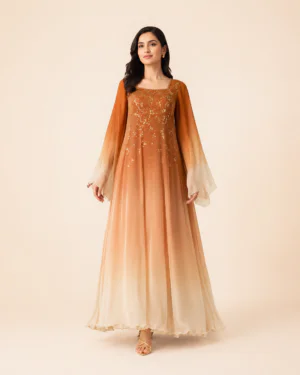
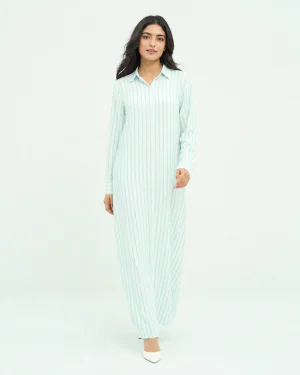
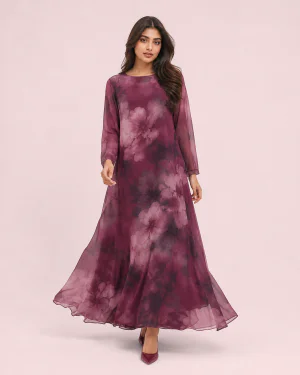
Our maxis are floor-length pret in chiffon, georgette, and crepe, split across printed, solid, and detailed lines. The silhouettes run A-line, empire waist, and anarkali-cut fit-and-flare. Most of them would read as long western dresses in any market — the Pakistani modesty is simply built into the cut.
Tops
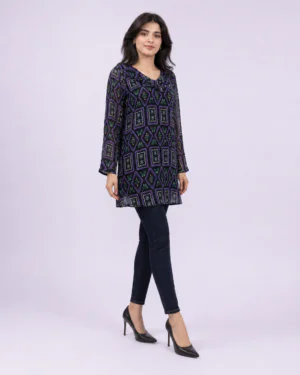
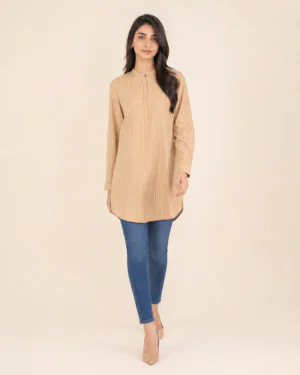
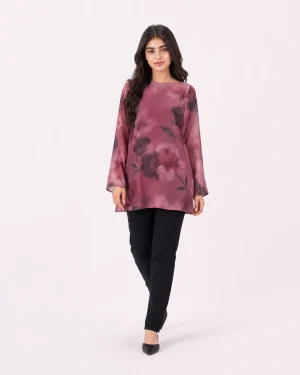
The tops are kameez-length tunics in western cuts, made to pair with trousers, palazzos, or jeans. They are modest in cut, finished in-house, and come in prints and solids that hold up across seasons. Of everything in the catalog, this is the easiest piece to fold into daily wear.
Co-ord sets
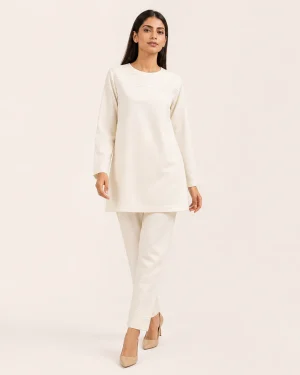
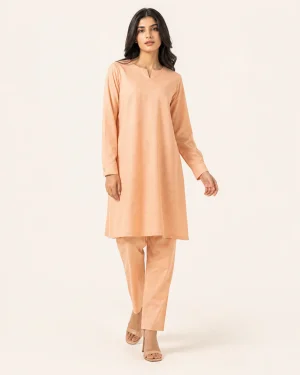
A co-ord set is a matched two-piece where the pairing is already decided for you: a kameez or tunic top with trousers, palazzos, or wide-leg cuts in the same print and fabric. It is sold and styled as one outfit — a western 2-piece set, cut and stitched as Pakistani pret.
Kaftans
Our kaftans are loose, full-length pret in soft fabrics, cut with wide sleeves and full coverage. They are the western-pret answer for eid mornings, family gatherings, and the kind of home day that still deserves a real outfit.
Lounge wear
The lounge sets are soft cotton, made for indoors — matching tops and bottoms in easy fits, with fabric chosen for how it feels eight hours into the day. It is western loungewear kept modest in cut.
Dupattas
A dupatta works as a finishing piece on its own. We make them in printed, embroidered, and plain silks and chiffons, cut to layer over a kameez, a kurta, or a co-ord already in your wardrobe — the bridge between western-cut pret and traditional Pakistani styling.
Exclusives
Exclusives are small-run designs that begin with an idea we did not want to repeat — fifteen pieces, sometimes thirty, made once and not restocked when they sell.
Western dresses by occasion
Most women come to a western dress with an occasion already in mind. The catalog groups easily across the ones that come up most often.
Party wear
Our western party wear dresses come in chiffon, crepe, and silk, with embroidered necklines, fitted bodices, and fuller skirts. They are cut for the evening that asks for something more decided than a kameez and palazzo, and they keep long sleeves, modest lines, and floor-length hems while they do it.
Wedding events
For the wedding calendar, we cut maxis for mehndi, nikkah, walima, and bridal wear. The silhouettes — A-line, empire-waist, fit-and-flare — sit in fabrics and embroidery that read properly at a Pakistani wedding, and they hold modest necklines, long sleeves, and full hems throughout. Browse the full wedding maxi collection for everything tagged across the event categories.
Eid
Our eid outfits sit in lighter chiffons and georgettes, in solid colour or a quiet print. They are cut to carry you from the morning visits through to the evening invitation, in the palettes Eid tends to call for: pastels, ivory, soft greens, blush, and sage.
Summer
For the hot months we lean on lightweight maxis, tunics, and kaftans — chiffon over a fine lining, breathable cotton co-ords, kaftans cut loose enough to move with the air. These are western summer dresses built for Pakistani heat, which means they stay long and modest while staying genuinely light.
Winter
When it cools down, the catalog shifts to velvet, crepe, and heavier-weight chiffon, mostly in solids: burgundy, emerald, midnight navy, plum. The cuts keep long sleeves and full coverage, and the fabrics are chosen to hold a shape against the cold — western winter dressing picked for the season, not adapted to it.
Formal and office
The formal pieces are made for the office, for evening events, and for occasions that ask for restraint. They stay in solid colour or a quiet print, with clean lines, finished hems, and no embellishment that would pull focus away from the wearer.
Western dresses by length and silhouette
Most Elrare pieces are long. The catalog runs to floor-length maxis and full-length kaftans, with tunic tops cut to the knee or mid-thigh to wear over trousers.
Long western dresses
The floor-length silhouette runs across the whole catalog. Whether it is A-line, empire waist, anarkali fit-and-flare, or a tiered hem, each one is cut to fall clean to the floor with the proportions already resolved. Long western dresses in Pakistan tend to split two ways — lighter chiffon and georgette for evenings, structured crepe and silk for occasions — and Elrare carries both.
For the longer read on what makes a Pakistani long dress work — fabric weight, sleeve choice, neckline architecture — see our complete maxi dress guide.
Western long frocks
The vocabulary overlaps here. What western pret traditions call a “long dress” is what Pakistani retail still calls a “long frock,” and the garment underneath is the same: floor-length, fitted bodice, fuller skirt. Both names point at the same rail, so the long frock collection holds pieces filed under either label.
Western maxi and maxi-style cuts
These are maxi-cut dresses, western in shape, built on a fit-and-flare bodice and empire waist with soft chiffon over a lining. The silhouette is western and the pret fabric is Pakistani. Browse our maxi-frock collection for the pieces that wear both labels at once.
Anarkali-style western dresses
The fit-and-flare bodice and fuller skirt of anarkali pret translate cleanly into western dress vocabulary, and the cut keeps a modest neckline, long sleeves, and a floor-length hem. See anarkali-style maxis for the designs cut in this shape.
By colour, pattern, and fabric
A few words on the catalog’s palette and material decisions.
Colour
The solids run through emerald, burgundy, midnight navy, ivory, dusty rose, sage, plum, and mauve. Black western dresses hold their place for the occasions that ask for restraint — a quiet evening, an office event, a wedding where the dress is meant to be the second-most-noticed thing in the room. White and cream pieces sit ready for nikkahs and the softer events.
Pattern
Our floral maxis cover botanical leaf, scatter floral, trailing stems, watercolour washes, and paisley, printed across both light and dark grounds. Where a print is not the point, the solids let the cut and the colour carry the dress on their own. The chikankari maxis sit on lawn and chiffon grounds for anyone who wants detail without applique or heavy embroidery.
Fabric
Each fabric does a particular job. Chiffon is there for drape, georgette for weight without bulk, crepe for structure. Silk goes into the occasion pieces, lawn into spring, cotton into everyday and lounge wear, and velvet into the winter solids. None of it is pulled from a roll of whatever was in stock — every fabric is sourced for the specific design it ends up in.
The modesty principle
Modesty at Elrare is a design property, not a moral position. Cut, line, length, and fall are all decided before a piece reaches the floor. Necklines stay above the collarbone. Sleeves run long or three-quarter unless the design specifies otherwise. Hems fall to the floor on maxis and kaftans, and to the knee or below on tunics worn with trousers. What you will not find anywhere is a mini length, a plunging neckline, or a sleeveless cut without a layering option.
This is not modesty as compromise. It is modesty named in the same register as fabric weight or sleeve cut — a structural choice the design team makes once, finishes properly, and ships. Restraint is the finish, not the absence of intention.