
Long is the most familiar silhouette in Pakistani womenswear.
A floor-length dress that hangs from shoulder to ankle has been the everyday shape of the kameez, the anarkali, the maxi, and the long frock — four words for what is, on the body, often the same garment. The vocabulary has shifted across generations. The silhouette has not.
This guide is for the reader who wants the whole picture in one place. What a maxi dress is in modern Pakistani usage, where the long frock fits alongside it, what the anarkali brought to both. The fabrics that work and the ones that do not. How a single maxi reads at a mehndi versus at a quiet evening at home. Sizing in pret, where the cut is decided upstream. Care, after the piece is yours.
We write this as a maker. Where we link out to the Elrare maxis collection, or to a specific tag inside the maxis cluster, we are pointing the reader at the actual piece — not interrupting the explanation.
What a maxi dress is — and where the long frock fits
A maxi dress, in Pakistani pret usage, is a finished floor-length women’s garment, sold in standard sizes, worn as a single piece.
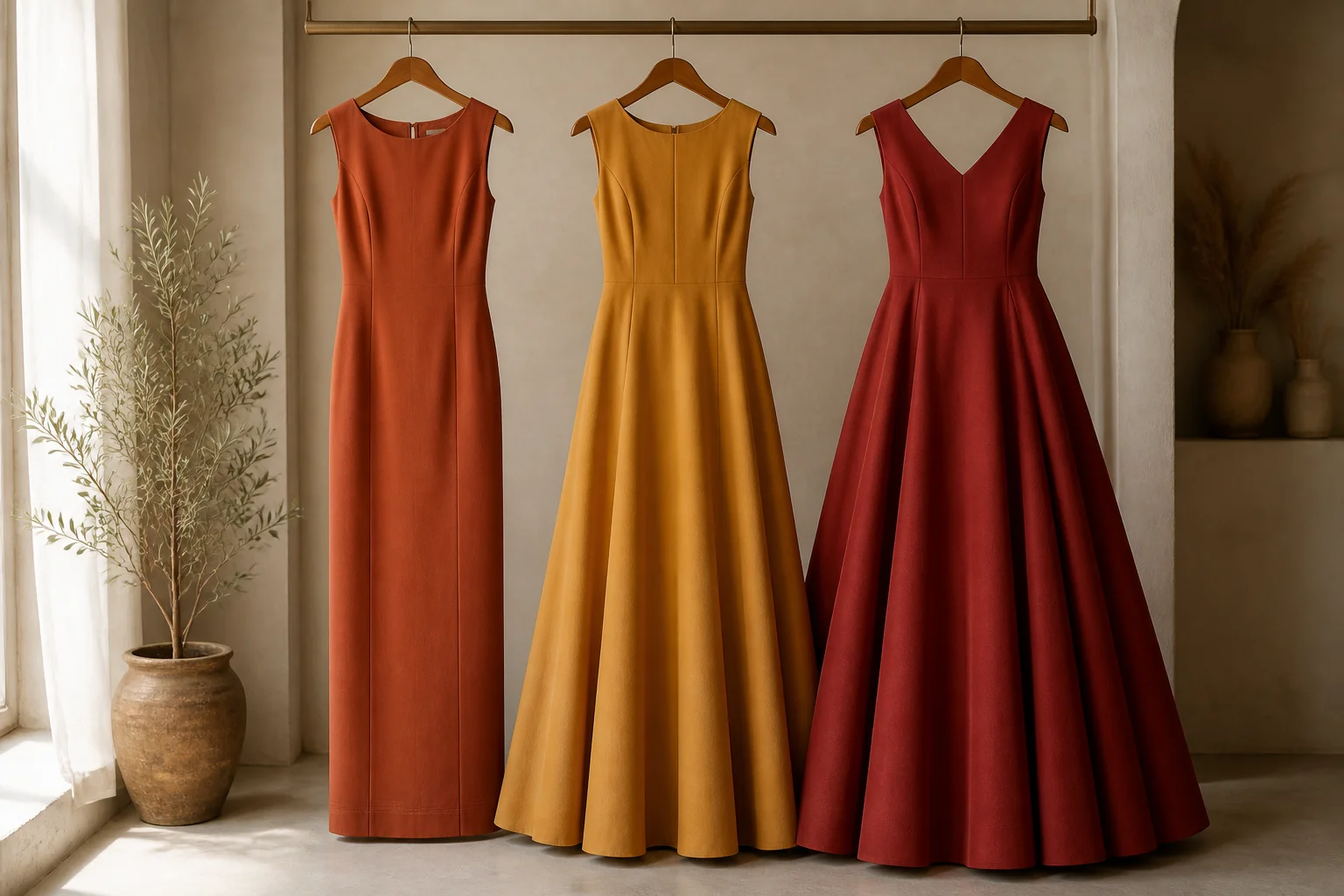
The defining property is length. A maxi reaches the ankle or the floor. It is cut as one garment rather than as a separated top-and-bottom pair, and it is sized through the bodice and the waist rather than tailored to a measurement. Below that one rule, the silhouette is broad. A maxi can be A-line, empire-waisted, fit-and-flare, or column-straight. The neckline can be round, V, square, boat, or notched. Sleeves can be full-length, three-quarter, bell, fitted, or sheer.
The long frock is the same garment, named in older vocabulary. “Frock” entered Pakistani fashion through the colonial-era dress register and stayed in it longer than it stayed in English elsewhere. In current Pakistani usage, a long frock is a floor-length women’s piece — sometimes synonymous with a maxi, sometimes naming the slightly fuller, more flared variant that descends from the anarkali silhouette. Pakistani buyers who type “long frock design” into a search bar are usually shopping for the same shape another buyer would type “maxi dress” to find.
A useful way to hold the two words together: the maxi is the shape, the long frock is the cultural noun. The garment is shared.
Inside the Elrare catalog, everything that is floor-length and one-piece sits in the maxis category. That includes silhouettes a different vocabulary would call long frocks, anarkali frocks, designer frocks, and maxi frocks. The reason for the single category is purely practical — the buyer who wants one is usually shopping for any of them.
What sits outside the maxi category: tops, co-ords (the two-piece set), kaftans (which are a separate silhouette, looser, often sleeve-led), lounge wear, and dupattas. Those are their own categories with their own conversations.
Vocabulary — maxi, frock, long frock, anarkali, gown
The five words that overlap most are maxi, frock, long frock, anarkali, and gown. They are not interchangeable, but the differences are smaller than the conversation around them suggests.
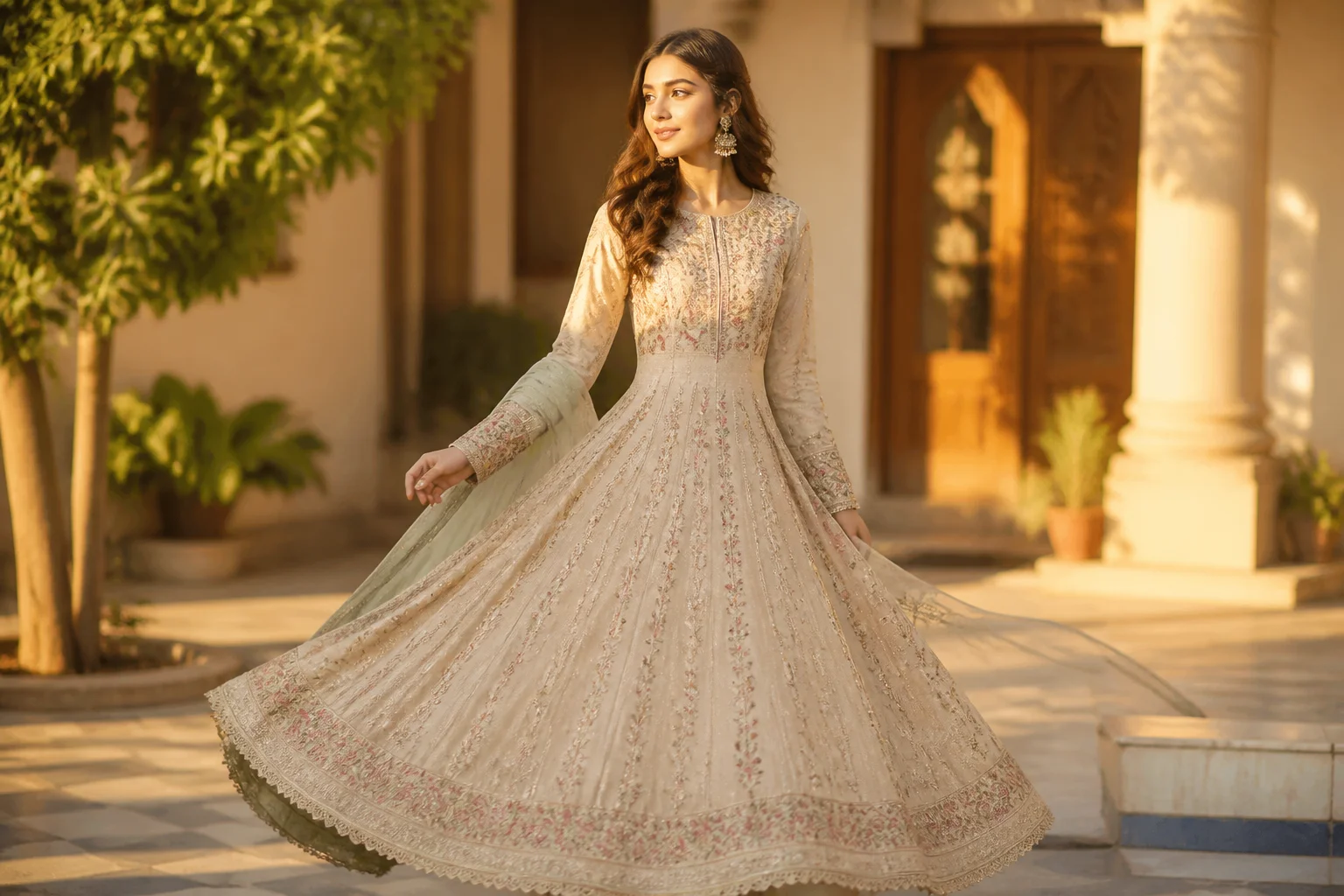
Maxi. A floor-length dress, single-piece, finished. Imported into Pakistani fashion through the 1970s wave of Western dress vocabulary; settled into Pakistani usage as the default English-language word for a long, fitted, contemporary dress. Read commercially: a buyer searching “maxi dress pakistan” is looking for a pret floor-length piece in modern silhouette and modern finish.
Frock. Older. In Pakistani English a frock is a fitted bodice with a flared skirt, often falling to the knee or mid-calf in its shorter form and to the ankle in its longer form. “Frock” is also the umbrella term in the designer frock vocabulary — designer frocks, embroidered frocks, party frocks. The word reads slightly more traditional than maxi, slightly more occasion-leaning, slightly more flared.
Long frock. The longer cut of the frock. The word has its own commercial gravity in Pakistan — the search query long frock pakistan is one of the highest-volume terms in the cluster — because for many Pakistani women, “long frock” is the native description of the silhouette they actually wear. Often used to name a more flared, fuller, festive piece than a column-straight maxi would be.
Anarkali. The grandmother of both. Named for the legendary courtesan of the Mughal court, the anarkali is a fitted bodice that releases into a wide flared skirt at the waist or the empire line. Worn long. The term is occasion-heavy, embroidery-friendly, and still in working use. A modern pret anarkali is usually finished as an anarkali-style maxi — a fit-and-flare floor-length silhouette that nods to the heritage cut without staging it. “Anarkali frock” reads as a buyer’s blend of the two vocabularies, naming the silhouette and the garment in one phrase.
Maxi frock. A bridge word. Maxi frock is what a Pakistani buyer types when she means a piece that is long like a maxi and flared like a frock — the visual midpoint between a column maxi and a full anarkali. The word is more common in commercial copy than in everyday speech.
Gown. Distinct. A gown reads as evening, often Western-influenced, often more structured and less culturally Pakistani than a maxi or a frock. We mention it here because the search vocabulary occasionally overlaps (“long frock gown style”), but at Elrare we do not stock gowns. A gown is a different garment family.
A working rule for the buyer: if you are unsure which word to use, use maxi if you want a modern, fitted, contemporary read; use long frock or anarkali if you want a flared, festive, slightly more traditional one. The catalog will surface most of the same pieces either way.
A short history of long-length wear in Pakistani fashion
Floor-length wear is older than the words for it.
The kameez — the long shirt that has been a Pakistani staple for centuries — has historically sat anywhere from mid-thigh to mid-calf, depending on era. By the late 1970s the long kameez was reaching the ankle, and the line between a long kameez and a maxi started to blur. The anarkali, revived as a costume choice in 1960s Pakistani and Indian cinema, gave the long flared shape a name with cultural weight. Through the 1980s and 90s, the long-flared silhouette stayed in occasion wear — mehndi, nikkah, eid — while shorter cuts dominated daywear.
The pret turn changed it.
Through the 2000s and early 2010s, as Pakistani womenswear shifted from a primarily unstitched market to a primarily pret one, designers started finishing long-length pieces as standalone garments rather than as components of a three-piece suit. The maxi became its own item — a single garment, fitted, sized, sold off the rail.
The vocabulary settled in parallel. Maxi became the standard English-language word for the modern pret long dress. Long frock held on as the older, Urdu-friendly word that buyers naturally reach for. Anarkali stayed in occasion contexts and never quite let go.
What sits in the Pakistani pret catalog in 2026 is a wider long-length range than at any point before. Casual day maxis, embroidered occasion long frocks, anarkali-style fit-and-flares, festive walima maxis, lawn summer maxis, velvet winter long frocks — all sit in the same shopping conversation now. The reader of this guide is shopping a category that did not, in this form, exist twenty years ago.
The fabric guide — seven fabrics, when each works
Fabric is the load-bearing decision in a maxi. The cut tells you what shape the garment holds. The fabric tells you how it moves, how it photographs, how it breathes, and what kind of day it can hold.
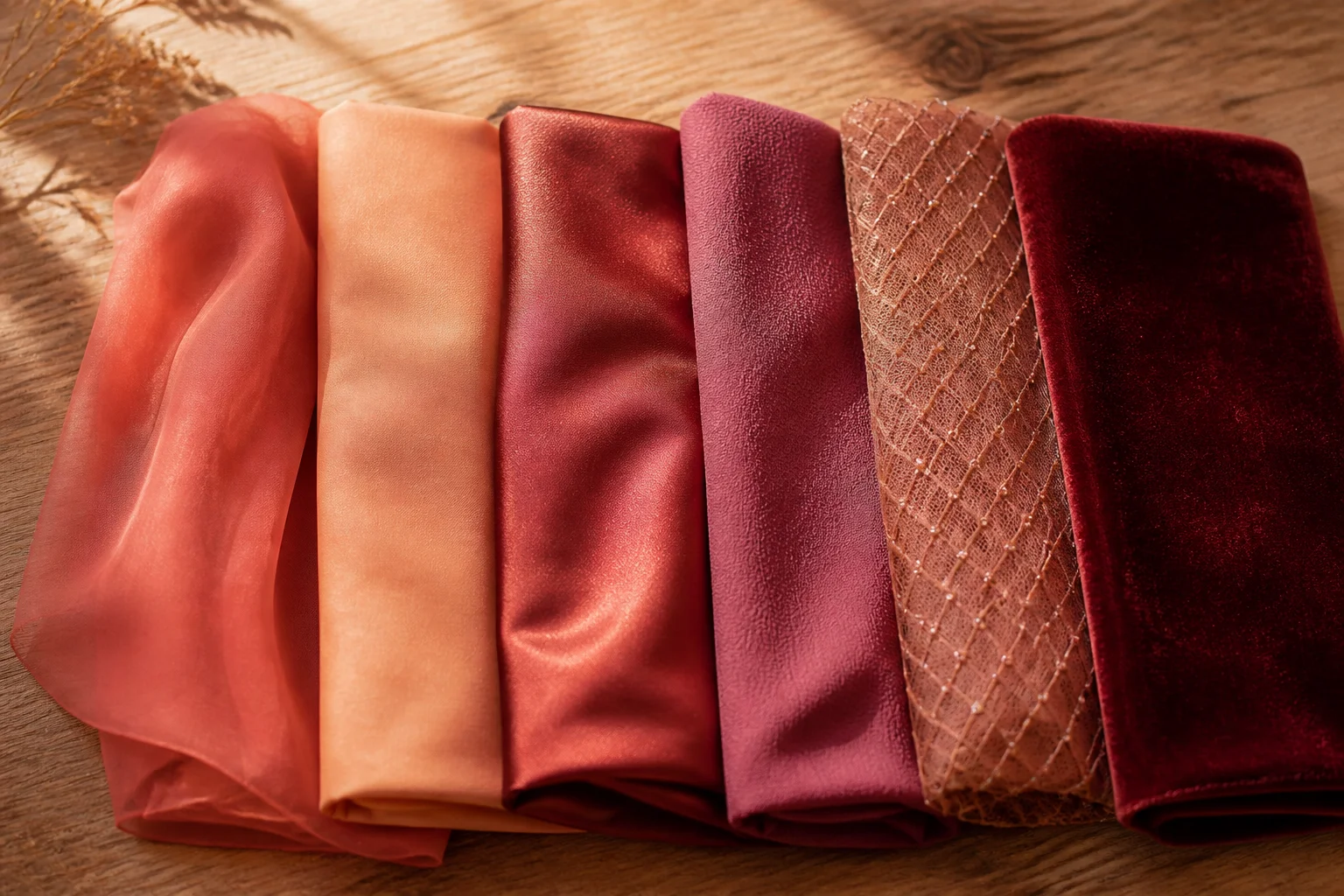
Seven fabrics carry most of the modern Pakistani maxi catalog.
Chiffon. Sheer, lightweight, drapey, soft. The fabric that built the modern occasion maxi. A chiffon maxi reads festive without reading heavy — the floor-length skirt has movement, the sleeves can be cut sheer, the colour reads cleanly. Chiffon takes embroidery well; a chiffon maxi with resham thread floral or schiffli cutwork along the hem and yoke is one of the canonical Pakistani occasion silhouettes. The trade-off is structure. Chiffon falls; it does not hold. For a piece that needs to keep a defined waist or a sharp sleeve line, chiffon usually needs a lining or a structured underlayer.
Lawn. Pakistani summer, full stop. Lawn is a fine cotton weave — soft, breathable, prints well, washes well, takes the heat. A lawn maxi is the everyday summer floor-length piece for Pakistani women, and the lawn season — March through September — is the high season for it. Lawn maxis tend toward print-led rather than embroidery-heavy, because the fabric itself does so much of the work. Plain solid lawn is also a quietly underused silhouette; the fabric reads minimalist beautifully when it is uninterrupted.
Cotton. Heavier than lawn, more structured, equally breathable. A cotton maxi sits in the casual-to-mid-occasion zone — too informal for a walima, exactly right for a daytime engagement, an eid morning, an afternoon family gathering. Cotton holds an A-line silhouette better than chiffon. It does not photograph with the same shine, which is sometimes the point.
Silk. The occasion fabric. A silk maxi reads polished, structured, slightly formal. Real silk and high-quality silk-blend both work for occasion wear; the touch on the body is what gives the piece its register. Silk takes embroidery well — gota patti, zardozi, tilla — and the sheen of the fabric reads against soft daylight in a way that lighter fabrics do not. The care cost is real: silk does not wash forgivingly and stores best in soft fold.
Georgette. Between chiffon and silk. Georgette has the fall of chiffon with slightly more body — it is a useful middle fabric for a maxi that needs to hang cleanly without going limp. A georgette maxi takes pleating, ruching, and self-tie waist treatments well. The texture reads more matte than silk and slightly more substantial than chiffon. It is one of the most forgiving fabrics in the Pakistani occasion catalog.
Net. Sheer, structured, slightly stiff. Net maxis are almost always embroidered — the fabric is a backdrop for resham, dabka, sequin, and pearl work. Net carries weight differently from chiffon; an embroidered net maxi hangs heavier and reads more occasion-formal. The right register for a nikkah, a walima, or a festive evening event where the embroidery is the centre of the garment.
Velvet. Winter, evening, and embroidery-led pieces. A velvet maxi reads rich, deep-toned, and seasonal — wine, emerald, navy, black, deep gold. Velvet takes embroidery in zardozi, tilla, and dabka the way few other fabrics do. It is also warm; a velvet long frock is a winter occasion piece for Pakistani women, designed for December-through-February events. Velvet does not breathe; do not buy it for summer.
A note on embroidery. The fabric is the canvas, but the embroidery is what often decides whether a maxi reads festive, every-day, or somewhere in between. Chikankari — the hand-thread shadow-work tradition — sits at the quiet-formal end. Mirror work, gota patti, and zardozi sit at the festive end. The same chiffon base can land in three different registers depending on the embroidery decision made on top.
Print decisions are part of the same vocabulary. A floral maxi reads soft and feminine and works almost anywhere on the calendar. A solid-colour piece reads minimalist and lets the cut carry the look. A black maxi is a different register again — quiet, sharp, weight-anchored — and earns its own place in the catalog.
Styling the maxi — ten outfit notes for Pakistani occasions
We do not tell readers how to wear a dress. We describe what the dress is and let the reader place it. What follows is a set of observations from the studio side — patterns that have proven to work, written so the reader can decide.
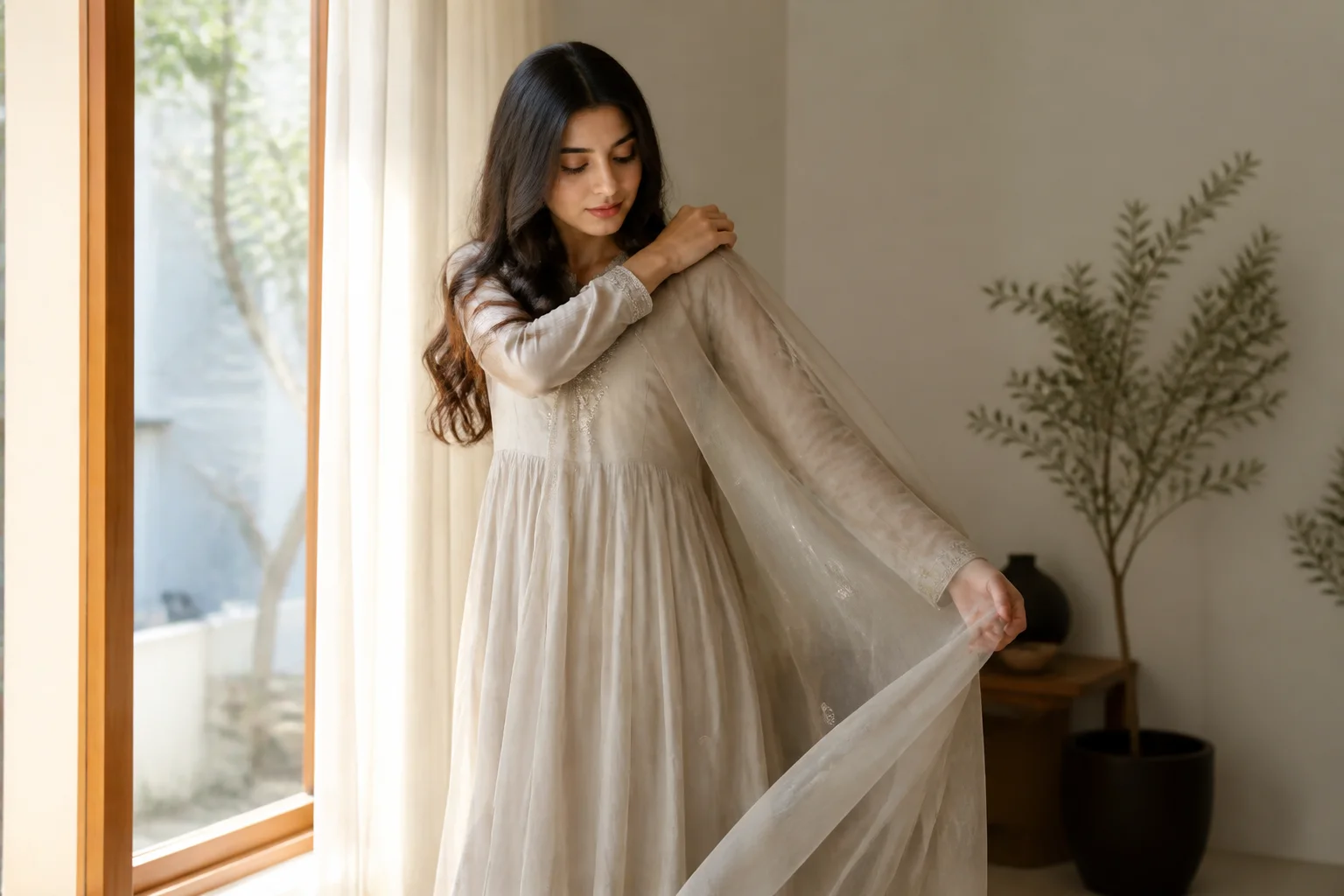
1. The dress is the look. A well-cut floor-length maxi does not need pairing. Heels or simple flats, soft natural hair, one quiet pair of earrings. The garment carries the rest. Over-styling a maxi is one of the most common mistakes — adding statement jewellery, layered scarves, contrast belts — and it usually reads against the line of the dress, not with it.
2. Self-finish over add-on. A self-tie belt at the waist, a self-fabric border at the hem, pintuck detail across the bodice — these define the silhouette without adding a second layer. The cleaner version of “accessorising” a maxi is to choose a piece whose finishing already does the work.
3. The dupatta is a register decision. A maxi worn without a dupatta reads modern, single-garment, contemporary. A maxi worn with a dupatta reads occasion-leaning, festive, more traditional. Both are correct. Match the dupatta to the maxi in weight — a chiffon maxi takes a chiffon or net dupatta; a velvet long frock takes a heavier silk-blend dupatta. Avoid a third fabric.
4. Sleeve length tells the season. A full-length sleeve reads winter, formal, or modesty-considered. A three-quarter sleeve reads everyday and works across seasons. A sheer full-length sleeve splits the difference — long line, light feel — and is one of the most useful sleeves in the pret catalog for occasion wear.
5. The neckline anchors the styling. A round neck takes a single pendant or no necklace at all. A V neck takes a longer chain. A boat neck takes earrings, no necklace. A bow-tie or notched neck is a self-finished detail and reads best left alone. Read the neckline first, then decide.
6. Length is structural, not optional. A maxi is meant to sit at the ankle or just past it. Hemming a maxi short raises it into a different category — usually a long kurta or a midi — and changes how the silhouette reads end-to-end. If the length feels long in a fitting, walk in it for a minute before deciding.
7. Heels read with formal maxis; flats read with everything. A formal velvet or net maxi expects a low to mid heel. A lawn or cotton everyday maxi reads correctly with a clean leather sandal or a kohlapuri. The shoe choice is one of the few accessory decisions that the maxi itself does not make for you.
8. Hair carries more than jewellery does. A maxi photographs differently with hair worn loose, in a low knot, or in a soft side sweep. Each reads as a different register. Less is almost always more — heavy hair-styling tends to compete with the line of the dress in a way that minimal jewellery does not.
9. Layering happens at the shoulders. A long shawl, a fine silk scarf, or a structured jacket can be worn over a maxi without disturbing the silhouette — provided the upper layer drapes from the shoulders, not from the waist. Cropped layering tends to break the long line. For winter wear, a wool or pashmina shawl over a velvet long frock is a clean, generations-old answer.
10. The mirror is at full length, or it is wrong. A maxi only reads accurately when seen in a mirror that shows the full silhouette from shoulder to floor. The waistline, the flare, and the hem all live in the bottom half of the image. A half-length mirror will read a maxi as a kameez and a kameez as a maxi.
Occasion mapping — mehndi, nikkah, walima, eid, party, every day
Different occasions ask different things of the same garment family. What follows is the mapping the brand uses internally when planning which pieces to ship at which moment of the year.
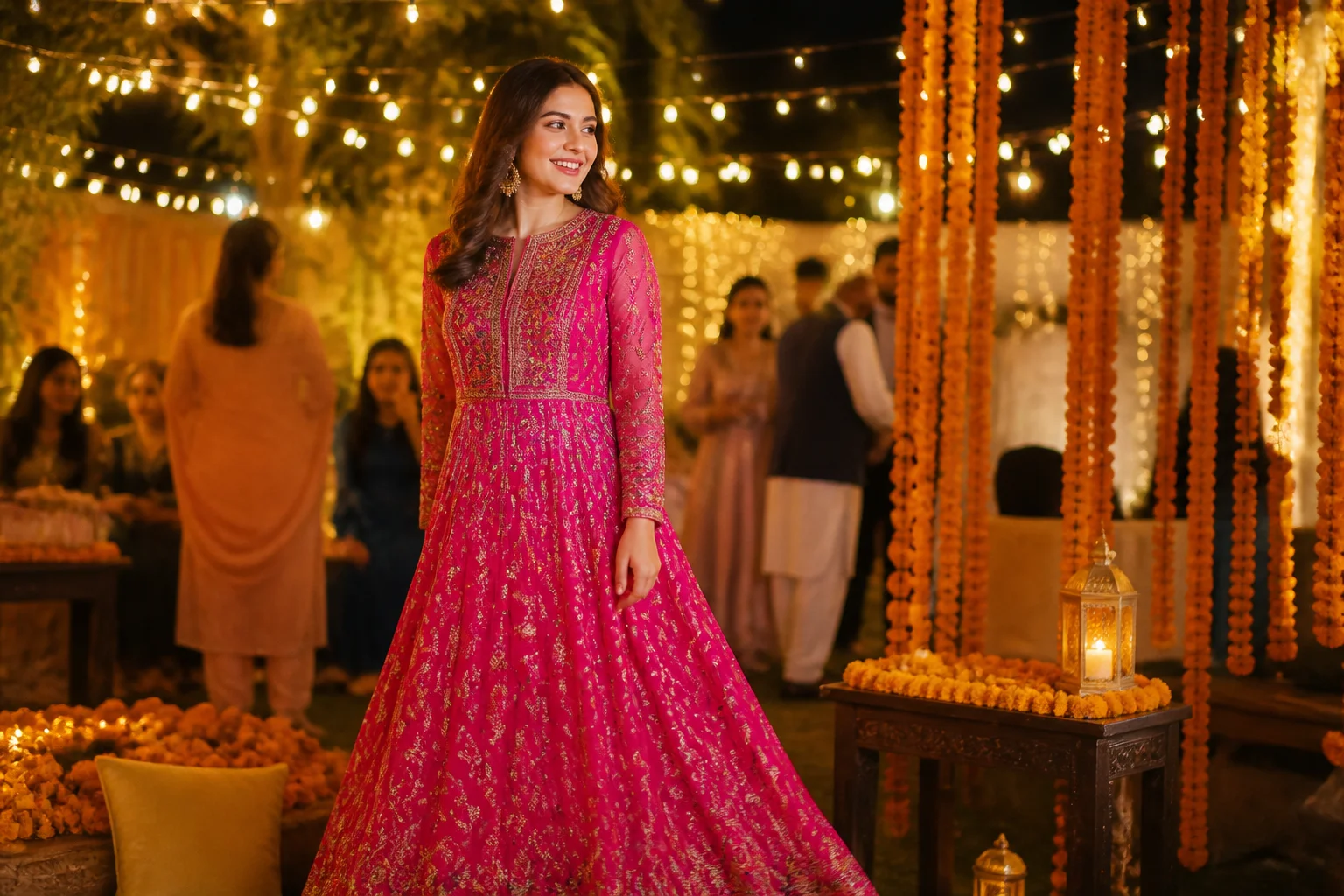
Mehndi. The loudest day of a Pakistani wedding. The maxi for a mehndi reads vibrant — magenta, mustard, marigold, green, deep coral. Embroidered, embellished, often with mirror work, gota patti, or schiffli detail. The silhouette is usually fuller and flarier than weekday maxis. The mehndi maxi tag is the dedicated tag for the category, and it is where buyers shopping the event itself tend to land.
Nikkah. The quietest day, and the most considered. Nikkah maxis read in cooler, lighter palettes — ivory, soft pink, blush, dove grey, mint, pale gold. The detailing is finer rather than louder: pearl work, fine resham, small-scale embroidery. The piece reads ceremonial without reading bridal. The nikkah maxi tag holds the current selection.
Walima. The reception. The second wedding day asks for a maxi that reads festive but lighter than a barat or a bridal piece — champagne, dusty rose, blush, dusty gold, soft ivory. A guest at a walima is reading the room; an Elrare maxi for a walima reads polished, structured, and slightly formal, without occupying the visual centre that the bride does. The walima maxi tag is where these sit.
Eid. Both Eid-ul-Fitr and Eid-ul-Adha are family-photograph occasions. The eid maxi sits in the bright-festive register — pastel pinks, mint, lilac, soft yellow, deep emerald, festive prints with fine embroidery. Often worn for the morning prayer and the family meal rather than a single evening event, so the garment needs to read clean from breakfast to lunch. The eid maxi tag is the seasonal tag, refreshed yearly.
Party and evening. Birthdays, dinners, anniversaries, eid evenings, soirees, family celebrations — the between-zone of the Pakistani social calendar. The party-wear maxi reads slightly bolder than everyday — deeper colours, structured cut, often a notched or square neckline, often a defined waist. Heeled. The party-wear maxi tag holds this register, and it overlaps with the wedding-leaning pieces but stays its own conversation. For the broader wedding arc — every event from mehndi to walima — the wedding maxi tag sweeps across the whole calendar.
Every day. The most under-appreciated register. An everyday maxi — a lawn floral, a cotton solid, a soft chiffon in a quiet palette — does not announce itself, and that is the point. It carries through lunch with family, a brief errand, an afternoon at home, an evening drop-in to a friend’s. The kind of piece that earns its place by not asking for one.
A note on bridal. Elrare is occasion-leaning ready-to-wear, not a bridal house. The bridal maxi tag exists for buyers who want to see what reads bride-side from our catalog, but the brand’s centre of gravity is the guest, the family member, and the host — not the bride herself. If a piece reads bridal, it does so because the cut and the embroidery happened to land there, not because the brand staged it as such.
Sizing and fit — how a pret maxi reads on a Pakistani body
Pret resolves sizing upstream. A maxi from Elrare arrives in Small, Medium, or Large — three sizes, designed to fit a range of Pakistani builds without the customisation a tailor would do.
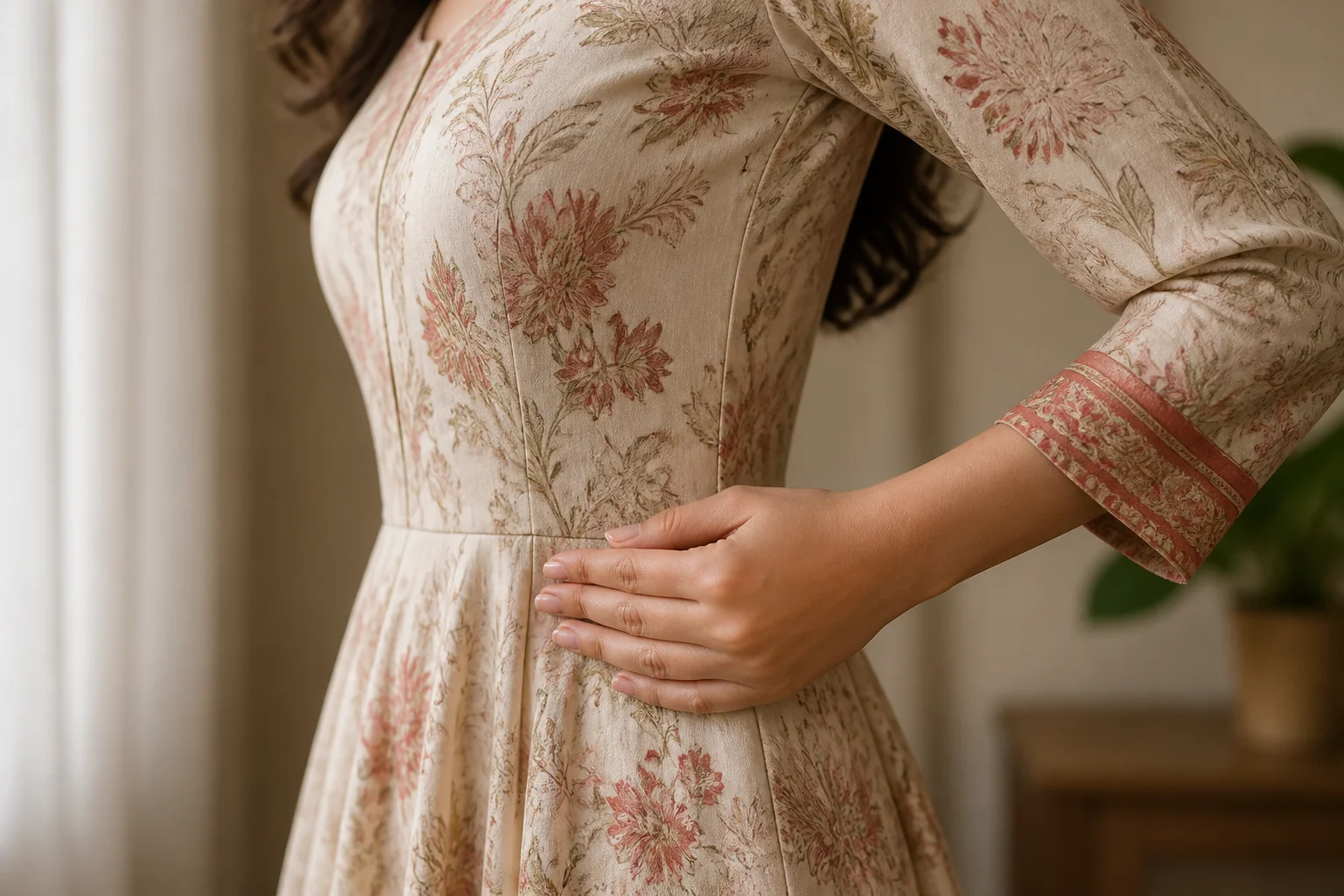
The bodice is the load-bearing decision. A maxi is sized through the bust, the waist, and the hip — in that priority. If the bust fits, the rest usually does. If two sizes are close, choose the smaller through the bust if the silhouette is column-straight, and the larger through the bust if the silhouette is A-line or empire-waisted — A-line maxis accommodate more bust ease without losing the line.
Length is built for an average Pakistani height of approximately 5’3″ to 5’6″. A taller wearer may find the hem at mid-ankle rather than floor; a shorter wearer may need a half-inch hem adjustment at the tailor’s. Neither is a fit failure; both are routine adjustments in the pret-to-tailor handoff.
Sleeve length is built for full-length finish. A three-quarter or bell-sleeve maxi reads to the wrist by design. If the piece is meant to be worn with bracelets, the sleeve will be cut to land just past the wrist bone, which is the silhouette to expect.
Neckline coverage is consistent across the catalog — modest in cut, designed to sit cleanly without pulling. If the piece feels tight at the neckline, size up before the bust dictates.
Care — laundering and storing a pret maxi
Care is fabric-specific. A pret maxi outlasts its first wear by several years if it is washed in the right register and stored without compression.
Lawn and cotton. Machine-wash cold, gentle cycle, inside out. Line-dry in shade. Iron on the back if the print is delicate.
Chiffon and georgette. Hand-wash cold with a mild detergent, or dry-clean for embroidered pieces. Lay flat to dry on a clean towel. Iron on the lowest setting through a thin pressing cloth.
Silk. Dry-clean only. Silk is unforgiving with water spotting, and the pret finishing is built for the dry-clean cycle. Avoid hanging silk maxis for long stretches; the shoulder line stretches under its own weight.
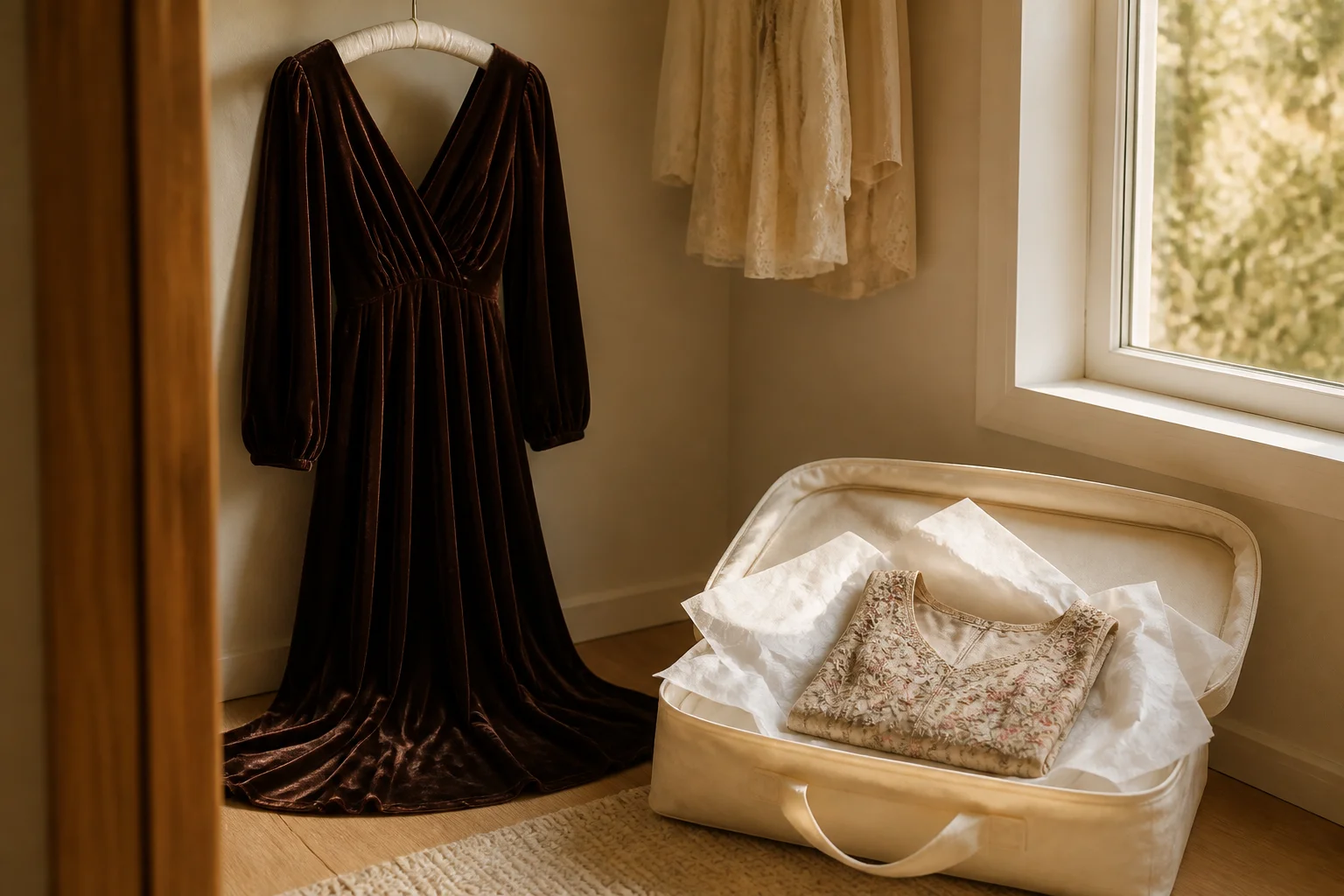
Net and embroidered pieces. Dry-clean. Hand-finishing on embroidery is not designed to take the water route. Store in soft fold with acid-free tissue between layers if the piece is heavily embellished — folding flat is gentler than hanging on heavy work.
Velvet. Dry-clean. Brush gently with a soft-bristle clothes brush after each wear to keep the pile aligned. Store on a wide padded hanger; velvet is heavy, and a thin hanger leaves shoulder marks.
A general note: avoid storing any maxi in plastic for long stretches. Cotton garment bags breathe; plastic traps humidity. For the Pakistani climate — particularly the monsoon months — this matters more than it does in drier markets.
Where to buy a maxi or long frock in Pakistan
The modern Pakistani pret market has changed what “buying a maxi” looks like. Most of the buying happens online — the buyer browses the catalog, reads the description, checks the fabric, looks at the sizing chart, decides at home, and the piece arrives at the door.
What to read for, when buying:
- The fabric, named specifically. “Embroidered chiffon” tells you more than “luxury fabric.” “Resham thread floral with mirror detail” tells you more than “intricate embroidery.”
- The cut, named clearly. “A-line, floor-length, round neck, full-length sleeves” reads as a finished piece.
- The size range. Most pret runs in Small, Medium, and Large. A brand that names the actual range is more likely to have built the cut around it.
- A return or exchange policy, in real terms. The pret market in Pakistan has matured enough that 7-to-10-day exchange is the working standard.
Elrare publishes new long-length pret to the maxis category regularly. Each piece arrives finished, in Small, Medium, and Large, with the fabric named, the cut described, and the occasion register implied rather than dictated. The catalog sits inside the wider Pakistani pret conversation — pret as the modern default for Pakistani womenswear — and the maxis category is one of its busiest rooms.
Frequently asked questions
What is the difference between a maxi dress and a long frock?
In modern Pakistani usage the two words name what is essentially the same garment — a floor-length, single-piece, finished women’s dress. “Maxi” tends to read as the more modern, fitted, contemporary English-language word, and “long frock” reads as the slightly older, slightly more flared, Urdu-friendly word. The same piece can be sold under either label depending on which buyer the catalog is speaking to. The shape is shared; the vocabulary is generational.
Are maxi dresses formal enough for a Pakistani wedding?
Yes — depending on the fabric, the embroidery, and the cut. A chiffon, silk, net, or velvet maxi with appropriate embroidery is one of the canonical Pakistani wedding silhouettes, worn at mehndi, nikkah, walima, and baraat events by guests and close family alike. The piece that is too informal for a wedding is usually a plain lawn or cotton maxi in an everyday palette; the piece that is right is a structured cut in an occasion fabric with detailing matched to the event.
Which fabric is best for a Pakistani summer maxi?
Lawn first, cotton second. Both breathe, both wash well, and both carry the Pakistani summer heat from March through September without making the wearer hot. Lawn takes print especially well; cotton holds an A-line silhouette better. For an occasion-leaning summer maxi, a lightweight cotton-silk blend in a quiet palette reads more festive without crossing into winter-fabric territory.
Can a chikankari maxi be worn for occasions other than nikkah?
Yes. Chikankari is often associated with nikkah and quiet-formal events because the shadow-thread embroidery reads ceremonial, but the same craft also works for a daytime mehndi, an eid morning, a family lunch, or a weekday occasion where the wearer wants a finished long-length piece without high embellishment. The colour palette tends toward whites, creams, ivories, and pastel base shades — match the rest of the palette to the event, and the chikankari does the rest.
How do I choose a maxi for my body type if I am petite?
Length and silhouette do the most work. A petite wearer often reads cleanest in an empire-waisted or A-line maxi rather than a column-straight one — the empire line shortens the bodice visually and lets the skirt do the floor-length work. A high round or V neckline lifts the line. Avoid hems that cover the foot; a half-inch tailor adjustment is routine, and a maxi that sits just at the ankle reads taller than one that drags. Three-quarter sleeves can also help; full-length sleeves can read longer than they need to.
How should an embroidered maxi be washed and stored?
Dry-clean rather than hand-wash, in almost every case. The finishing on embroidered pret is built for the dry-clean cycle — water-wash risks dulling the embroidery thread, loosening dabka or zardozi work, and shrinking the base fabric unevenly. For storage, soft fold with acid-free tissue between layers is gentler than hanging, especially for heavily embellished pieces. Keep the garment in a cotton bag rather than plastic — Pakistani humidity, particularly during the monsoon months, can mark embroidery if the piece is trapped in non-breathing storage.