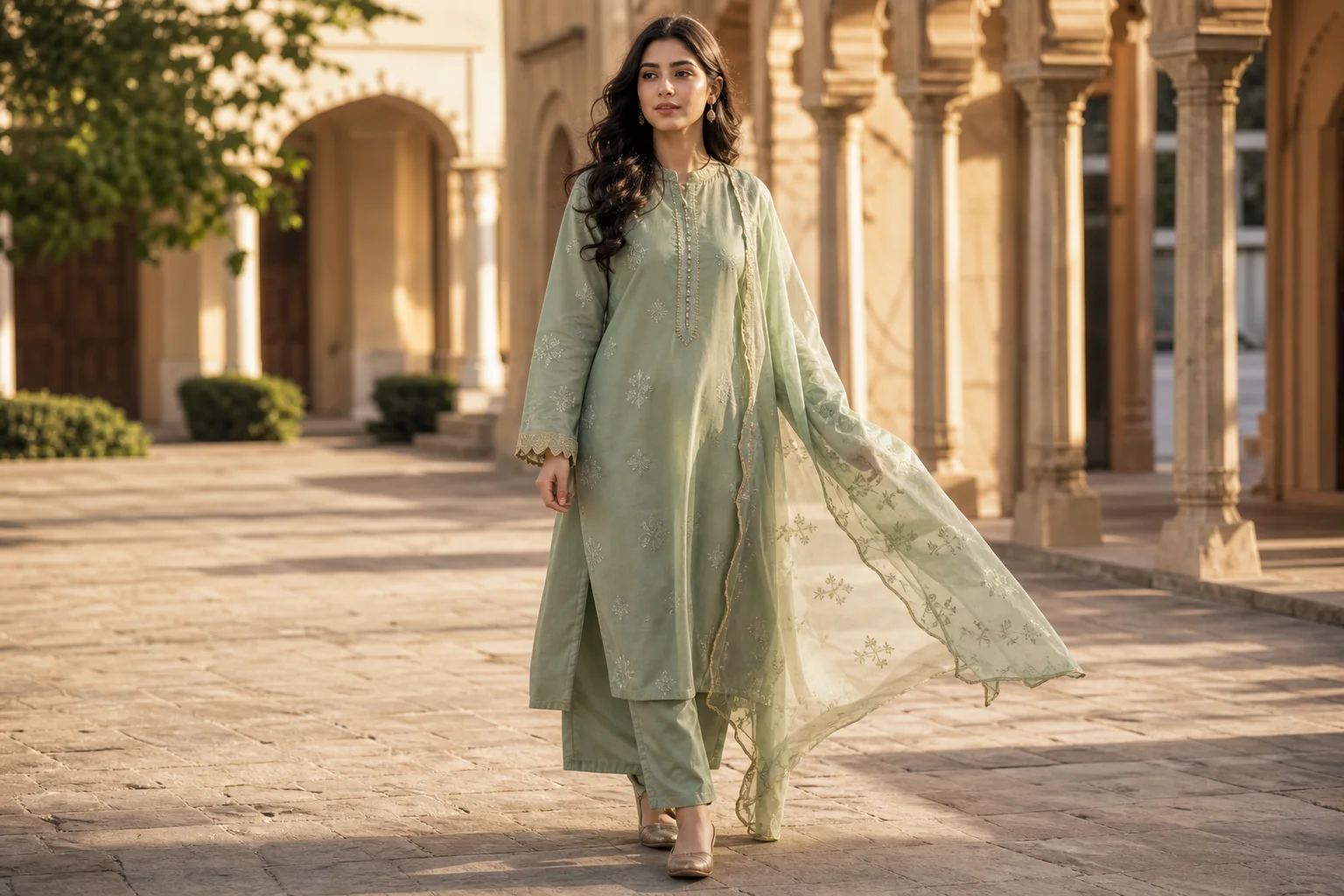
Pret is the modern default for Pakistani womenswear.
It is the clothing most women in Pakistan actually buy now — finished, fitted, available in standard sizes, ready to wear out of the bag. A generation ago that was rare. Now it is the way the catalog opens.
This guide is for the reader who wants the whole picture in one place. What pret means. How it relates to the older unstitched habit. Which garment categories sit inside it. What the fabrics are doing. How to read price honestly. Which pieces work for which occasions. How to choose, and how to make a piece last.
For readers who only want the definition in one read rather than the full tour, a shorter standalone explainer of what pret means in modern Pakistani fashion sits alongside this guide.
We write this as a maker, not a stylist. Where we mention a piece from our own catalog, we do it to anchor a category, not to interrupt the explanation.
What is pret?
Pret is short for prêt-à-porter — French for “ready to wear.” In Pakistan the word has been local for a long time. It now means a finished womenswear garment, manufactured in standard sizes, sold off the rail.

The opposite of pret in the Pakistani sense is not “couture.” It is unstitched fabric — yardage you buy as cloth and take to a tailor. That second route still exists and still works. But pret has shifted from the smaller share of the market to the larger one. For most women buying clothes in Pakistan today, pret is the first option they reach for.
Three things make a garment pret in modern usage:
- It is sold finished. Hems, seams, embroidery, lining, buttons, ties — all done at the studio or workshop level before the piece reaches the buyer.
- It is sized to a standard size range. Small / Medium / Large is the common pattern, with some brands extending the range. Custom alterations may still happen, but the piece is designed to fit a size, not a person.
- It is part of a designed collection. A pret piece sits inside a thought-through line — fabric chosen, colour chosen, silhouette resolved by the in-house design team before any one customer enters the picture.
That last point is what separates pret from the older “stock garments” idea. Pret pieces are designed. The fabric is sourced for the design, not pulled from a roll of whatever was in stock. The cut belongs to a season or a collection. The finishing matches the price tier.
“Ready to wear” and “pret” are now used interchangeably in Pakistan. They mean the same thing on the catalog page. The two terms exist in parallel because one is older and slightly more formal-sounding; the other reads as a plain modern description. Most brands use both.
For readers who want that vocabulary unpacked at length — why the two words exist side by side and what the twenty-year shift behind them looks like — there is a separate piece on ready to wear versus pret.
Pret vs unstitched — the Pakistani fashion divide
The cleanest way to understand pret is to set it next to its older sibling: unstitched.

Unstitched is fabric. You buy a kameez piece, a shalwar or trouser piece, and a dupatta — typically three pieces, sometimes two — and you take the bundle to a tailor. The tailor measures you, asks about the neckline, the sleeve length, the fit through the bodice, and then sews the garment to your specifications. That whole loop — fabric purchase, tailor consultation, fitting, finishing — used to be the default. For an entire generation of Pakistani women, it was the only way to get a kameez or a maxi that fit.
The system has real strengths. The fit is exact. The neckline can be drawn to your preference. The cut can be modernised or kept traditional depending on the tailor. And the fabric range in the unstitched market is wider, especially in heavy embroidered and bridal segments.
The system also has real costs. The tailor is a separate skill purchase. Turnaround is measured in weeks, not days. Sizing mistakes compound — fabric cut wrong cannot be undone. The buyer is essentially commissioning a one-off garment every time, with all the time and coordination that implies.
Pret resolved most of those frictions by moving the cut decision upstream. The brand resolves silhouette, neckline, sleeve length, and finishing before a single piece is sold. The buyer is offered a finished garment in a few standard sizes. Fit is a sizing decision, not a tailoring decision.
That trade — losing exact custom fit, gaining time, consistency, and a designed silhouette — turned out to be the right one for most Pakistani women buying day-to-day clothes. Unstitched still owns occasion-heavy and bridal territory. Pret owns everything else.
The piece you are reading is published by Elrare, which is a pret house. Everything in our catalog arrives finished, in Small, Medium, and Large, with the design decisions already made. We do not run an unstitched line. That is not a critique of unstitched — it is simply a different business.
For readers weighing the two systems for an upcoming purchase, we keep a fuller comparison of pret versus unstitched with the decision-points laid out garment-by-garment.
A short history of pret in Pakistan
Pret as a category did not exist in the modern Pakistani sense until roughly the early 2000s. Before that, the womenswear market broke into two slabs: heavy bridal couture at the top, and unstitched fabric at scale below it. The middle — designed, finished, off-the-rail garments at an accessible price — was nearly empty.
A handful of design houses started filling that middle. Some emerged from the textile mills, extending their fabric business into ready garments. Others started as independent studios, building small finished collections from scratch. The early pret offering was uneven — sizing inconsistent, finishing rushed, fabric thinking limited. It took a decade for the category to find its rhythm.
By the mid-2010s the pret market in Pakistan was substantial. By 2020 it was the default. The acceleration through 2021 and 2022 was driven by online retail — buyers gained confidence buying a sized garment without seeing it on, and the pret brands gained reach beyond their original cities.
What sits inside pret in 2026 is broader than what sat inside it ten years ago. Maxis, tops, kaftans, co-ords, lounge wear, dupattas, and small exclusive collections all read as pret now. A piece can be casual or occasion-leaning and still belong to the category — what matters is that it arrived finished.
The vocabulary has settled too. “Pret” reads as confident shorthand. “Ready to wear” reads as descriptive. “Pakistani designer dresses” reads as the commercial query a buyer types when she is shopping rather than reading. All three point at roughly the same shelf.
For the wider aesthetic context — what modern Pakistani fashion looks and reads like in 2026 beyond the pret category alone — see a piece on the year’s aesthetic shifts.
The pret catalog at a glance
What follows is the modern pret catalog mapped to garment categories. Every category we make at Elrare is below; each one links to its own landing page where the current pieces are listed. Read this as a tour, not a table of contents — the categories are related but the silhouettes, fabrics, and occasions diverge.

Maxis
A maxi is a floor-length one-piece dress, fitted at the bust or empire waist and flowing through to the hem. In modern Pakistani pret the maxi is the workhorse occasion garment — it covers more events than any other single silhouette.
Fabric choice carries most of the personality. A chiffon maxi reads as soft and ceremonial; a crepe maxi reads as structured and contemporary; a cotton maxi reads as everyday. Embroidery and finishing decide register — a plain colour maxi with a clean cut works for a family dinner; the same silhouette in chiffon with resham thread floral becomes a mehndi piece.
Maxis in Pakistani pret are almost always modest in cut: round or modest V neckline, long or three-quarter sleeves, no slits unless the design specifically calls for one. The floor-length silhouette gives the fabric room to fall, and that fall is most of what makes the piece work.
Available in the Elrare maxis collection across plain, printed, and embroidered finishes. Sizing is Small, Medium, and Large.
Tops
Tops in Pakistani pret cover the kameez-length tunic, the cropped kurti, the shirt-length top, and a range of silhouettes in between. Worn over trousers, palazzos, churidars, cigarette pants, or jeans — the bottoms are the buyer’s choice; the top carries the design.
What separates a pret top from a generic kurti is the same thing that separates pret from unstitched anywhere — the cut is resolved, the finishing is done, the piece arrives ready. Sleeve length is set, neckline is set, hem detail is set.
The tops we make are modest in cut and finished in-house before they leave the studio. Most of the range sits at tunic length — long enough to read as a kameez, short enough to be worn with structured trousers without overwhelming the silhouette.
Tops live at the Elrare tops collection across plain, printed, and embroidered options.
Kaftans
The kaftan is the kindest silhouette in pret. Loose, falling from the shoulder, no waist seam, no fitted bodice — what holds it together is the fabric and the print.
For a kaftan the fabric does almost all the work. A soft chiffon kaftan reads as evening. A printed crepe kaftan reads as smart-casual. A linen-blend kaftan reads as resort or summer-loose. The cut is consistent across the category — what changes is the textile and the embroidery, if any.
Kaftans are inherently modest. The shape covers the line of the body without effort and without compromise on grace. For readers who find fitted bodices uncomfortable in the hotter months, the kaftan is the most forgiving piece in the modern pret wardrobe — and one of the most occasion-flexible. Worn over a slip or a fitted base, it stretches from a Sunday lunch to a small evening event.
See the current range at the Elrare kaftans collection.
Co-ords
A co-ord is a matched two-piece set — a kameez or tunic top with matching trousers, sold as one purchase, worn as one outfit. The match can be exact (same fabric, same print throughout) or considered (top and bottom designed to sit together without literal print continuity).
What makes a pret co-ord work is the resolution. The top is sized to the bottom, the fabric drape is consistent across both pieces, the trouser cut suits the top’s length. The design team has already decided how the set hangs. The buyer does not have to assemble it.
Co-ords sit closer to everyday wear than maxis but read more deliberate than separates. They are the working answer for the buyer who wants to look pulled together without thinking through pairings.
Embroidered co-ords carry to dressier occasions; printed and plain co-ords carry the everyday end. The full range is at the Elrare co-ords collection.
Lounge wear
Lounge wear in pret is the indoor wardrobe — soft, breathable, easy to wear for a long stretch, designed to feel like clothes rather than sleep wear. A loose top with palazzo or wide-leg trousers, in cotton or jersey, in a print that reads relaxed.
The category exists because the alternative — Western pyjamas or unmatched indoor separates — never quite fits the way a Pakistani woman actually spends time at home. Lounge wear here is more clothed, more covered, designed to be photographed in if the family group calls in.
Cuts are forgiving by design. Fabrics are softer-weight. Prints carry the personality. Lounge wear is the easiest pret category to underestimate and the easiest to fall back into wearing daily once you own a few pieces.
The current set is at the Elrare lounge wear collection.
Dupattas
A dupatta is a long rectangular scarf, traditionally part of a three-piece outfit, increasingly a stand-alone accessory in modern pret. Length runs roughly 2.25 to 2.5 metres; width varies by style.
What changes a dupatta from a plain rectangle of fabric into a designed piece is the border. Resham thread floral, gota patti, schiffli cutwork, dabka, mirror work — the embroidery on the border (and sometimes throughout the length) is where the design lives. A printed dupatta carries differently — the print itself becomes the piece.
Dupattas pair with kameez tops, tunics, plain maxis (yes, a dupatta on a plain maxi shifts the register up an event), and co-ords. As a stand-alone purchase they extend an existing wardrobe without committing to a new outfit.
See the current range at the Elrare dupattas collection.
Exclusives
Exclusives is a meta-category — a piece in this collection can be a maxi, a kaftan, a co-ord, a tunic, or a dupatta. What holds the category together is design intent: pieces that began with an idea we did not want to repeat, made in small runs, not restocked the way the rest of the catalog is.
Some Exclusives use fabrics we sourced specifically for one design. Others use embroidery techniques in combinations the rest of the range does not carry. A few are simply pieces we wanted to make once.
The category is small by design. If a piece in it speaks to you, it is worth picking up — we do not create artificial scarcity, but Exclusives genuinely are not made in volume.
Elrare Exclusives holds the current set.
The fabric guide
What separates one pret piece from another, more than anything else, is the fabric. Cut and embroidery matter, but the cloth carries most of the decision. A buyer who learns to read fabric reads pret correctly.

Chiffon. Soft, sheer, light. Falls in deep folds and catches movement. The dominant pret fabric for occasion maxis. Often used over an opaque lining. Holds embroidery well but the embroidery weights down a sheer cloth, so heavy work shifts the fall.
Crepe. Slight surface texture, more structure than chiffon, less drape. Reads contemporary and slightly more substantial. Holds shape on a fitted bodice better than chiffon. Common in modern maxis and co-ords.
Lawn. Light cotton, breathable, the workhorse of Pakistani summer wear. The unstitched market is built on lawn; pret uses it across everyday tops, tunics, and lighter co-ords. Holds print sharply.
Cotton (heavier weights). Beyond lawn, heavier cotton works for kameez tops, structured co-ords, lounge sets. Less drape, more body. Reads relaxed and durable rather than ceremonial.
Organza. Stiff, sheer, holds its own shape. Used on dupattas, statement sleeves, and accent overlays — rarely as the body fabric of a full garment because the stiffness reads costume-y at large scale.
Linen / linen-blend. Hot-month favourite. Breathable, slightly textured, gets softer with wear. Works on kaftans, lounge sets, and lighter co-ords. Wrinkles by design; do not fight the wrinkle.
Silk and silk-blend. Higher tier, less common in pret day-wear, more common in occasion pieces and small exclusive runs. Holds colour deeply, drapes with weight, finishes with a quiet sheen.
How fabric reads on the body matters more than the fabric name on the page. The same silhouette in chiffon and in crepe is two different garments — one will float, one will sit. When choosing between two pret pieces of the same cut, the fabric is usually the deciding factor.
For a current view across the fabric range, see the Elrare maxis collection.
Fabric is one of three properties that decide how a single pret garment reads on the body — the other two are fit and finishing. A longer read on women’s pret in Pakistan — fabric, fit, and finishing walks through all three at the level of evaluating one garment before purchase.
The pricing reality of premium pret
Premium pret in Pakistan sits in a particular price bracket — above mass-market high-street, below stitched-to-order couture and bridal. It is its own tier, and the price reflects four costs honestly: fabric, in-house design time, finishing, and small-run volume.
Fabric is the largest single line. A chiffon or crepe sourced for a specific design — chosen for weight, drape, colour-fastness, and how it takes embroidery — costs more than a generic bolt. Embroidery is the second line, and varies widely by technique. Resham thread floral on a neckline is one cost; full-body zardozi is another order of magnitude.
In-house design is real but invisible to the buyer who only sees the final piece. Someone decided the maxi was burgundy and not the cheaper magenta. Someone decided the bodice should be ruched and not gathered. Someone resolved the sleeve length to long sheer rather than three-quarter. That work is upstream and silent, and it is part of what the buyer pays for.
Finishing is the easiest to undervalue because it is the easiest to do badly without it being immediately visible. Seam allowance, hem weight, lining, button quality, the way an embroidery sits against the underlying fabric — these decide whether the piece holds up after the third wear or the third wash.
Small-run volume is the last cost. Premium pret is not produced at fast-fashion scale. A run of fifteen or thirty pieces per design carries higher per-unit cost than a run of fifteen hundred. That is the trade for a designed collection rather than a printed catalogue.
We do not write price language into product copy. The storefront carries the number. The work of describing the garment — the cut, the fabric, the finish — is what justifies the number, and that work happens in the description, not in superlatives around it.
Pret by occasion — a working map
Pakistani pret maps to occasions, but most pieces are flexible enough to carry across two or three registers if the buyer is clear about what they are doing. Below is a working map, not a prescription.
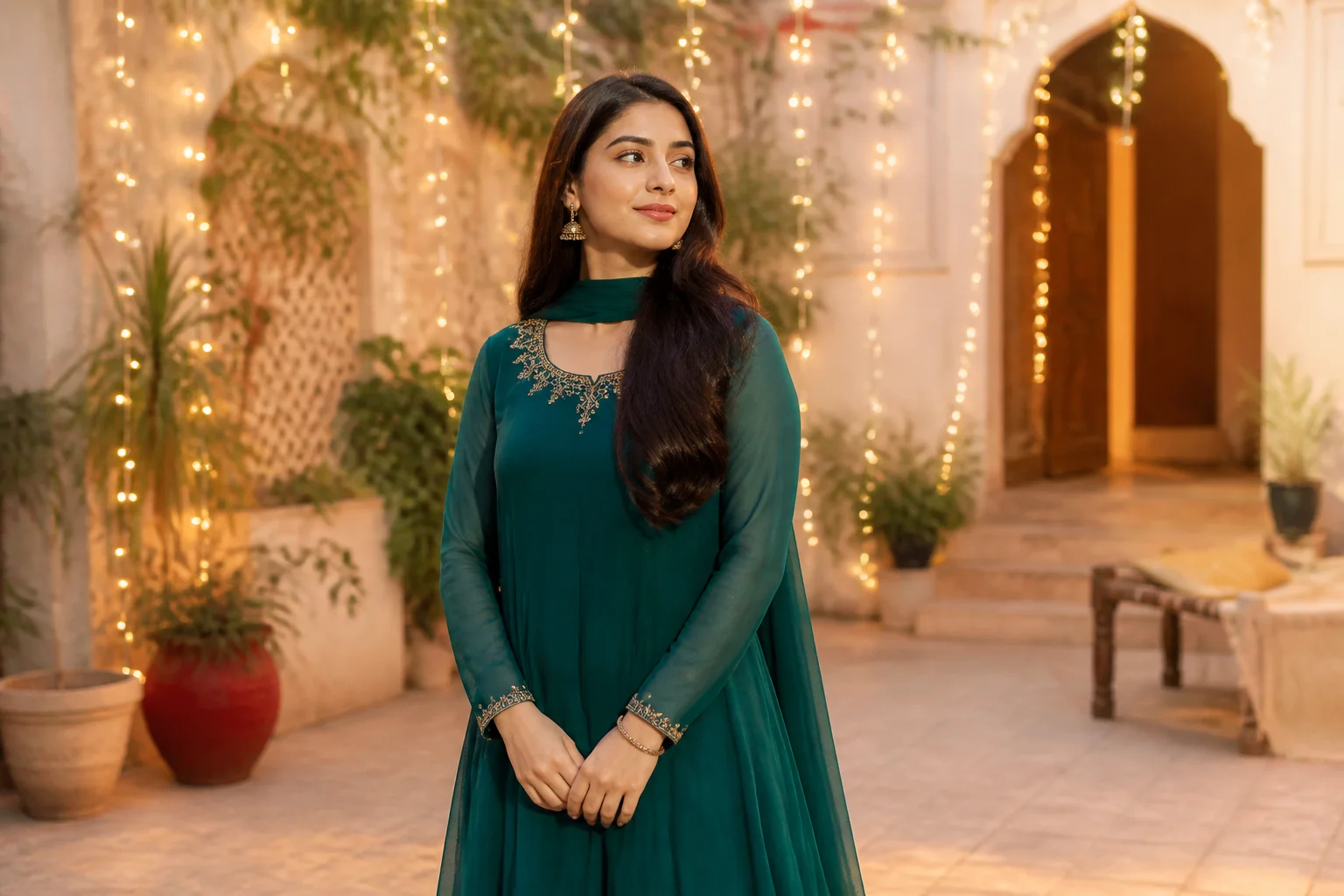
Mehndi. Bright fabric, lighter embroidery, easier movement. A chiffon maxi in a saturated colour — magenta, emerald, sunshine yellow — with resham floral or schiffli detailing reads as a mehndi piece. Co-ords work too if the print carries festive energy. Avoid the heaviest embroidery weight; mehndi calls for fabric that moves with the dancing. For options aligned to this register, see mehndi-leaning pieces.
Nikkah. Soft palette — ivory, blush, champagne, dusty pink — with refined embroidery rather than dense work. A clean-cut maxi in a soft colour with a worked neckline and sleeves carries the register. The day is solemn enough that simpler reads better than louder.
Walima. The second wedding day allows a wider range than the nikkah. Champagne, gold, deep jewel tones, ivory with worked embroidery — all read correctly. A maxi with weighted finishing or a co-ord with embroidered details fits the room. For walima-leaning pieces specifically, see walima maxi options.
Baraat. Higher gravity than mehndi, more colour than nikkah. Deeper reds, emeralds, midnight blues, with substantial embroidery work or hand-considered prints. A maxi is the default silhouette; a heavily embroidered co-ord works if the embroidery carries the weight.
Eid. Festive but not bridal. A bright maxi for eid day, a printed co-ord for the family visits, a softer kaftan for the evening — the wardrobe across the eid days flexes more than the single events of a wedding. Pieces should hold up to multiple wears across the three days.
Party / dinner. Smart-casual to occasion-leaning depending on the host. A printed crepe maxi, an embroidered co-ord, a refined kaftan — any of these carries a dinner. The cue is fabric weight: too heavy reads bridal-by-mistake, too light reads day wear in the wrong room.
Casual / everyday. Cotton tops with palazzos, lawn maxis in summer, lounge sets at home, plain kaftans in the hotter months. Everyday pret is the largest share of what a Pakistani woman actually wears across a year — and the part of the wardrobe that benefits most from honest fabric and clean finishing.
For an event-by-event companion piece that extends this map into specific garment recommendations, see how to choose pret for Pakistani occasions.
How to choose pret
There is no single right way to buy a pret piece. There is a useful set of questions that move a wardrobe forward instead of sideways.

Start with the fabric weight, not the print. A chiffon and a crepe in the same colour do different things on the body. Decide which fall you want, then choose the design inside that fabric.
Read the embroidery in proportion to the piece. Heavy embroidery on a light fabric weights the fall. Light embroidery on a structured fabric reads decorative without changing the silhouette. The question is whether the embroidery is helping the garment do its job or fighting it.
Choose the cut you actually wear. A buyer who reaches for maxis at home rarely converts to co-ords overnight. The pieces that earn their place in a wardrobe are the ones that match the buyer’s existing habits.
Pick the colour you will own. If a colour is outside the buyer’s usual palette, the piece often sits unworn after the first event. The wardrobe-building purchase is a colour the buyer will reach for repeatedly.
Check the size range and the size guide. Pret runs differently across brands. A Small at one house is a Medium at another. Always read the size chart, especially the bust and waist measurements rather than the size letter. For our catalog, see the maxi pillar at the maxi guide for cross-piece sizing notes.
Be honest about the occasion. If the buyer is shopping for a specific event, the piece should be evaluated against that event’s register — not against an aspirational future event. The piece bought for a wedding that may happen often becomes the piece worn nowhere.
These five questions resolve most pret purchases without overthinking. The sixth — does the buyer like the piece — is the one only the buyer can answer.
A longer companion read covers the same questions at the garment-design level — the best Pakistani designer dresses, a buyer’s guide for 2026. The questions are similar; the frame is wider.
Care and longevity
Pret garments are made to be worn — repeatedly, across seasons, in the kind of rotation that turns a wardrobe into a daily reality rather than a closet of single-event pieces. Care decisions extend that life by years.
Wash by fabric, not by habit. Chiffon and crepe go to dry cleaning by default. Lawn and cotton handle gentle machine wash on cold with inside-out positioning. Linen takes hand wash or delicate machine cycle; heat damage and aggressive spin are the two main risks. When in doubt, the dry cleaner is the safer call.
Embroidered pieces always dry clean. Resham thread, gota patti, zardozi, dabka — every embroidery technique used in Pakistani pret responds badly to home washing. The thread bleeds, the metallic trim tarnishes, the mirror work dulls.
Store on the hanger or folded by fabric. Maxis and long pieces go on hangers with shoulder support. Heavily embroidered pieces fold (the hanger weight distorts the embroidery line). Co-ords store as sets, not as separates.
Use cotton garment bags for the occasion pieces. Plastic bags trap moisture and discolour fabric. Cotton breathes.
Repair early, repair small. A loose thread on resham embroidery, a slipped seam at the underarm — both are five-minute fixes when caught early, and substantial repairs three wears later. Most pret houses repair their own work; ours included, within the Elrare exchange policy.
A well-cared-for pret piece holds for years. The fabric softens slightly with wear, the embroidery settles into the cloth, the cut starts to feel like the buyer’s own. That ageing is part of what the price was paying for.
Where to buy modern pret in Pakistan
The modern pret market in Pakistan is online-first. Most premium pret houses run their own websites, ship nationwide, and have outgrown the mall-based footprint that defined the category a decade ago.
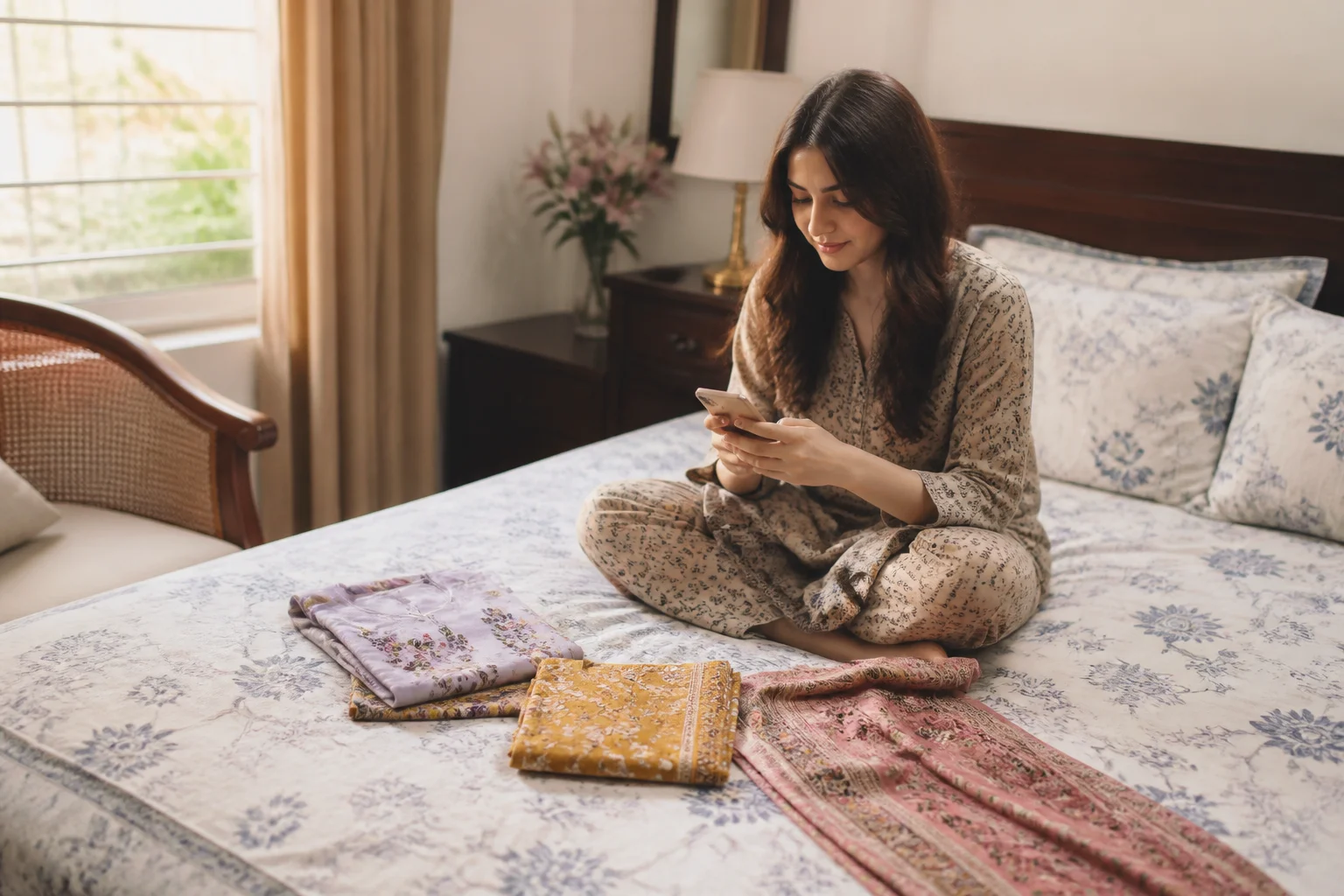
The decision the buyer faces is not where to shop, but which design philosophy to back. Some houses lead with print scale and seasonal volume — large collections released frequently, fabric chosen for cost-efficiency, embroidery sourced at scale. Other houses run smaller collections, slower release cadences, in-house design teams that resolve fewer pieces more carefully, fabric chosen for the design rather than for the calendar.
Elrare belongs to the second group. Our collections are smaller. The fabric is sourced for the design — we ask what the chiffon wants to become before we commission a print on it. The cut is resolved in-house, often after several rounds of sample work. The embroidery is applied to a finished bodice, not stamped across yardage and cut to size afterward.
This is not a critique of the volume-led approach. It is a different business with different strengths. A buyer who wants new options every two weeks is well served by the larger houses. A buyer who wants pieces designed slowly and finished carefully is the reader this guide was written for. More about how the team works is at the Elrare studio page.
For the buyer who has chosen pret and wants to commit to an online order from an unfamiliar house with full confidence, a longer guide on buying Pakistani dresses online covers product photography, size charts, fabric descriptions, and return windows.
Everything we make is available at the Elrare collection, in Small, Medium, and Large, ready to ship — no pre-orders, no waiting, no commissioned tailoring.
The harder question for a long-term wardrobe is not which piece to buy but which brand to buy from. A buyer’s decision guide for choosing a Pakistani clothing brand covers the design philosophy, fabric sourcing, finishing standards, and exchange policy that separate houses worth returning to from houses worth buying once.
Frequently asked questions
What is pret in Pakistan?
Pret is finished, ready-to-wear Pakistani womenswear sold in standard sizes. The word comes from the French prêt-à-porter and has been local Pakistani usage for two decades. A pret piece arrives stitched, finished, lined where needed, and ready to wear without further tailoring.
What is the difference between pret and ready-to-wear?
In modern Pakistani usage they mean the same thing. “Pret” is the shorter, more confident local term; “ready to wear” is the longer descriptive phrase. Most pret houses use both interchangeably. The distinction matters historically — pret entered the Pakistani vocabulary first — but in 2026 it does not affect what the buyer is looking at on a website.
Is pret the same as stitched-to-order?
No. Stitched-to-order is the older system where the buyer purchases unstitched fabric and commissions a tailor to sew it to her measurements. Pret skips that step entirely — the design house has already chosen the fabric, resolved the cut, and finished the garment in a standard size range. Pret saves time and removes tailoring uncertainty; stitched-to-order offers exact custom fit. The two systems are alternatives, not the same thing.
What sizes does Pakistani pret come in?
At Elrare every piece is available in Small, Medium, and Large. Across other Pakistani pret houses the range varies — some offer XS through XL, some run alpha sizes only, some include a separate “free size” cut for kaftans and looser silhouettes. Always read the brand’s size chart with bust and waist measurements rather than the size letter, since the same letter means different measurements at different houses.
Can pret be worn for weddings?
Yes. Modern Pakistani pret carries across the mehndi, nikkah, walima, and baraat events comfortably. Maxis in chiffon or crepe with refined embroidery are the most common wedding-event pret choice, and embroidered co-ords work for some events. Bridal couture — the full bridal lehnga or fully worked bridal kameez — sits outside the pret category and remains stitched-to-order territory; pret covers everything around the bride.
How is pret different from unstitched?
Unstitched is fabric — typically a three-piece bundle of kameez, trouser or shalwar, and dupattas fabric — that the buyer takes to a tailor for sewing. Pret is the finished garment, sewn and sized before purchase. Unstitched is older and still dominates heavy embroidery and bridal segments; pret dominates everyday and modern occasion wear. Both systems coexist in the Pakistani market.
This guide is refreshed yearly. The pret market in Pakistan is small enough that what was true in 2026 may shift by 2027, particularly around fabric trends and embroidery technique combinations. Returning readers will find updated category sections, refreshed occasion notes, and any new garment types that have entered the catalog since the last revision.