Something in the Pakistani aesthetic has quietly moved over the last three years.
It is not a sharp pivot — it is a slow re-settling. The words “modern Pakistani fashion” mean something more specific in 2026 than they did in 2022, and the modern pakistani dresses our reader writes to us about now sit in a different register from the ones that filled the same rails three or four seasons ago. Quieter palettes. Lighter embroidery. Longer cuts. A confident return to the South Asian silhouette done in a cleaner, more considered way. The piece below is a read on what has shifted, where pret sits inside the shift, and what is staying put.
What “modern” means in 2026 (and what it used to mean)
For a long stretch — call it roughly 2015 through 2021 — modern Pakistani fashion was mostly a conversation about Western silhouettes adapted to Pakistani modesty norms. Empire-waist gowns with a dupatta thrown over one shoulder. Fusion cuts that tried to balance an A-line skirt with a kameez bodice. Half-sleeves with a sheer overlay added later. The work of the modern designer often felt like translation work — taking a European or American line and finding a way for it to read modest and culturally legible.
The 2026 reading is different. The translation phase has eased back. What sits in front of the reader now, when she scrolls through the pret pillar or walks through a curated rail, is a confident re-engagement with the South Asian silhouette in its own terms. The maxi. The kaftan. The co-ord. The unstructured tunic. Done in cleaner cuts, lighter embellishment, and quieter palettes than they used to be — but South Asian first, modern second.
This is the move worth naming. Modern is no longer a translation. It is a register the South Asian silhouette has settled into on its own.
Shift 1 — Quieter palettes, more confidence in neutral
The first shift is the easiest to see in a photograph. The non-bridal Pakistani wardrobe has moved toward champagne, blush, ivory, soft sage, dusty rose, and warm neutrals. The festive jewel tones — emerald, sapphire, ruby, deep magenta — are still in the wardrobe, but they are punctuation now, not the rule.

Part of the reason is that the reader’s everyday and semi-formal wardrobe carries more weight than it used to. A piece that has to read at an Eid lunch, a daytime nikkah visit, and a quiet family dinner without being changed in between earns its place by sitting in a softer palette. The saturated festive piece is still there — for the mehndi night, the baraat, the moment that asks for it — but it does not dominate the rail in the way it once did.
Designer pret in champagne and blush is no longer the daytime-only, daytime-nikkah-only option. It is closer to the default register the wardrobe sits in.
Shift 2 — Embroidery as detail, not as density
The second shift is on the surface of the garment. Heavy zardozi and gota patti work has not gone anywhere — true bridal wear and the high-formal walima register still ask for that density, and they get it. What has changed is everything below that register.
The everyday-to-festive middle of the wardrobe has shifted toward considered embroidery placed at the neckline or the hem, rather than full-bodice work. Schiffli cutwork. Fine resham in a single thread tone. Single-line motifs that follow a seam. Clean borderwork that reads as a finished edge rather than a decoration laid on top. The garment carries the embroidery; the embroidery does not carry the garment.
This is a register move, not a budget move. The reader who used to ask for “full embroidery, festive piece, ready for the evening” is now more likely to ask for “a maxi with quiet work at the neckline, ready for an evening that is dressed but not maximal.” That phrase did not really exist in the way it does now four years ago.
Shift 3 — The co-ord has gone mainstream
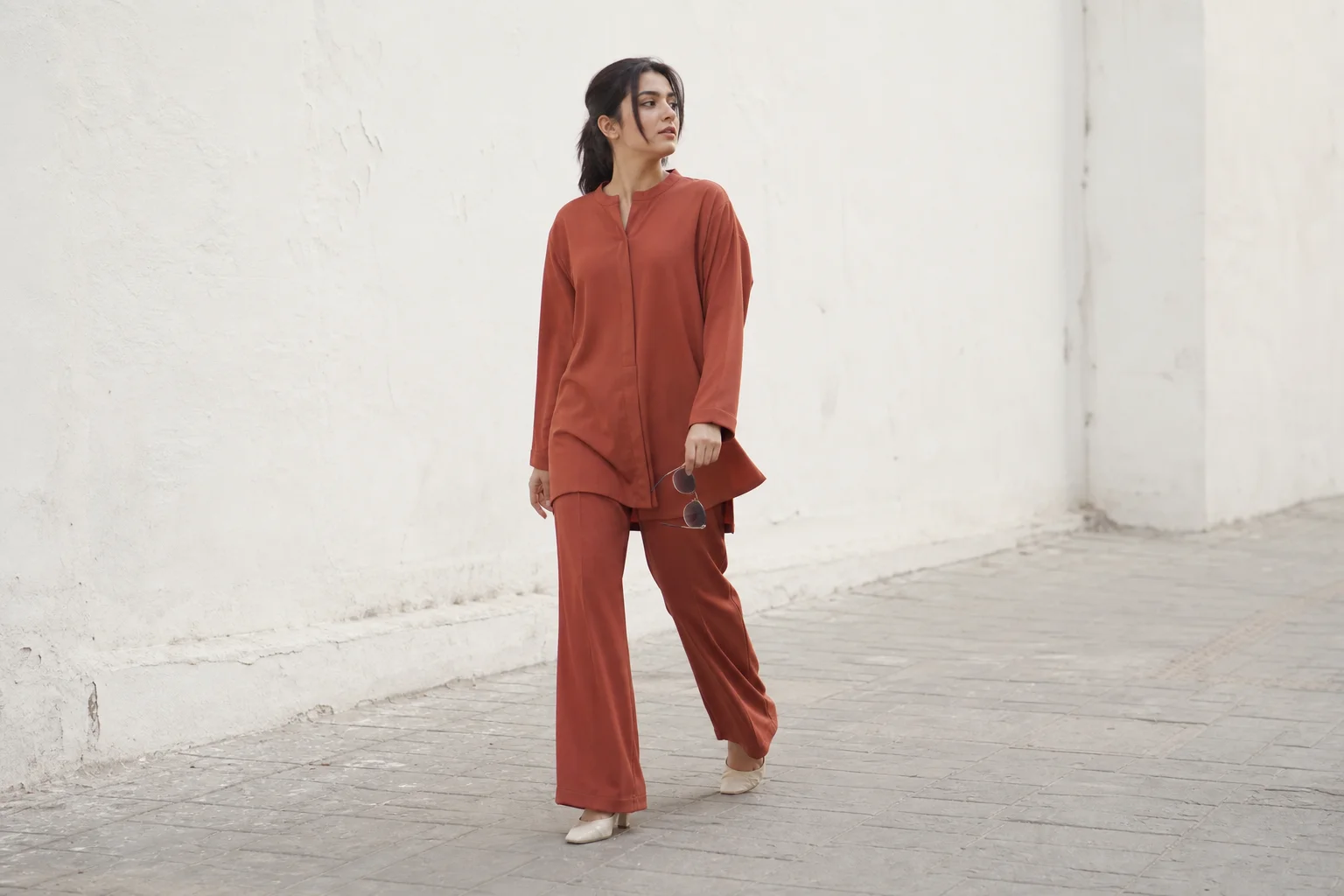
The co-ord set — kameez or tunic top paired with a matching trouser — has moved from occasional to default for a large slice of the modern wardrobe. Three years ago, the co-ord was a slightly adventurous choice for a younger woman at a casual evening. In 2026 it is closer to a default for dinners, family gatherings, Eid lunches, and the festive-adjacent middle of the social calendar.

Two things are doing the work. The first is the trouser line itself — it keeps the silhouette modern and dance-friendly in a way a floor-length maxi sometimes does not. The second is that the matched fabric still reads as a complete look in photographs, which is the way the reader is increasingly checking her own dressing before she leaves the house.
Embroidered co-ords in printed cotton, schiffli chiffon, or quietly embroidered crepe are landing where a printed maxi might have landed four years ago. Not replacing the maxi — sitting next to it.
Shift 4 — The kaftan as the new occasion-easy piece
The fourth shift is the kaftan’s repositioning. For a long time the kaftan was coded — in the Pakistani reader’s imagination, not necessarily in fashion writing — as either lounge wear or as a beachside garment for a summer trip. In 2026 it sits comfortably at a family lunch, a daytime nikkah, an intimate Eid gathering, a quieter walima where the silhouette is doing the work.
The reason is structural. The kaftan is inherently modest. It falls cleanly. It does not ask for waist fitting. The reader can pull one on and be appropriately dressed for an occasion within thirty seconds, and that ease maps onto exactly the kind of everyday-to-occasion question modern Pakistani fashion is asking right now.
A printed kaftan in cotton or chiffon for a daytime gathering. An embroidered modern Pakistani kaftan in a deep tone for a formal evening. The category answers a question very few other silhouettes do.
Shift 5 — Length, line, and the return of the floor
The fifth shift is the shape of the line itself. The shorter knee-length frock that had a moment around 2018–2020 has retreated. The floor-length maxi is back in focus across pret. Not as a one-piece silhouette dominating everything — more as a recognition that the longer line reads modern in 2026 in a way the cropped silhouette does not.

A note on cut. The work is being done by A-line maxis, empire-waist silhouettes, and clean column lines. The heavily fitted bodice with a wide flared skirt — the formal-prom shape that some Pakistani brands ran for a few years — has eased back. The reader is asking for line and fall, not for cinched-and-flared structure. The shape of the garment should feel like a single calm gesture, not a contoured exercise.
The dupatta has stayed where it is — draped, present, and quietly doing the work of finishing the look. Length on the kameez or tunic has crept back up to mid-thigh and below; the very short tunic with cigarette trouser is still around but reads as one option among several rather than as the modern default it briefly was.
Where pret fits inside the shift
The aesthetic shift maps onto pret as a category almost directly. Pret was always the answer to a particular question — “I want something considered, finished, ready to wear today, no stitching wait, no fitting fuss.” What has changed is what the reader wants that thing to look like.
Three years ago, the question pret answered was often “give me a festive-ready piece in saturated colour with full embroidery, available now.” In 2026, the question is more often “give me a piece in a quieter palette with considered embroidery and a longer line, available now.” The category did not change. The aesthetic the category serves did.
This is why pret has become a more interesting conversation than it was. A piece in a buyer’s guide to Pakistani designer dresses reads as a real design exercise now — fabric, fall, cut, the placement of a single embroidery line — rather than as a fast-turnaround festive option. The work has slowed down. The reader is paying attention to what slowed down.
The reader’s attention has shifted with the work. For the garment-level read on fabric, fit, and finishing — the three properties that decide whether a single piece carries this new quieter register — start there.
What is staying — the parts of Pakistani fashion that didn’t shift
The shift is a register move, not a rewrite. A few parts of the Pakistani wardrobe have stayed exactly where they were.

Modesty defaults are unchanged. The cuts are modest, the necklines are modest, the lengths are modest, and the reader still wants them that way. Wedding-event dressing — mehndi-bright, baraat-saturated, walima-composed — is still anchored to the occasion in the way it always has been; a baraat dress in 2026 still looks like a baraat dress, just done with a little more line and a little less weight. The fabric vocabulary is broadly the same: chiffon for the formal evening, crepe for the mid-formal middle, cotton for the everyday, organza for the lighter side of festive, breathable knits for lounge that wants to read as daywear.
The dupatta is still here. The kameez is still here. The categories Pakistani fashion has always organised itself around are still the categories Pakistani fashion organises itself around. What has moved is the register inside each of them. By 2026, that register is quieter, longer, lighter on its embellishment, and more confident in its own silhouette — which is probably the right read on what the words “modern Pakistani fashion” mean now, and the read worth carrying into the next year of dressing.
Frequently asked questions
What does “modern Pakistani fashion” mean in 2026?
In 2026, modern Pakistani fashion sits closer to a confident re-engagement with the South Asian silhouette — the maxi, the kaftan, the co-ord, the unstructured tunic — done in cleaner cuts, quieter palettes, and lighter embroidery than it was three or four seasons ago. It is the South Asian silhouette settled into a quieter register on its own terms, no longer a translation of Western shapes into Pakistani modesty norms.
Is the co-ord set replacing the maxi in modern Pakistani fashion?
No — the co-ord is sitting next to the maxi, not replacing it. The shift is that the co-ord has moved from occasional to default for a large slice of the wardrobe, especially for dinners, family gatherings, and the festive-adjacent middle of the social calendar. The maxi is still the answer for formal evenings, walima registers, and the occasions where length and fall do the work.
What colour palette is dominating modern Pakistani pret in 2026?
The non-bridal wardrobe has moved toward champagne, blush, ivory, soft sage, dusty rose, and warm neutrals. Saturated festive jewel tones — emerald, sapphire, ruby, deep magenta — are still in the wardrobe, but they are punctuation now rather than the rule. The everyday and semi-formal pieces carry the neutrals; the festive piece carries the colour.
Is heavy embroidery out of fashion in Pakistan?
For true bridal wear and high-formal walima dressing, no — heavy zardozi and gota patti work still answer those occasions and probably always will. For everything below that register, embroidery has moved toward considered placement at the neckline, hem, or seam — schiffli, fine resham, single-line motifs, clean borderwork. The garment carries the embroidery rather than the other way around.
Are kaftans considered modern in Pakistani fashion now?
Yes — the kaftan has repositioned itself from lounge-coded or beach-coded to a working occasion-piece for a family lunch, a daytime nikkah, an intimate Eid gathering, and a quieter walima. Its inherent modesty, clean fall, and no-fitting-fuss cut answer the everyday-to-occasion question modern Pakistani fashion is asking right now.
What length of dress is most modern in 2026?
Floor-length maxis and longer kameez or tunic lines are back in focus. The shorter knee-length frock that had a moment around 2018–2020 has retreated. A-line, empire-waist, and clean column silhouettes are doing most of the work; the heavily fitted bodice with a wide flared skirt has eased back. The reader is asking for line and fall, not for cinched-and-flared structure.
Where does pret sit inside modern Pakistani fashion?
Pret sits in the middle of the shift, almost directly. The category has always been the answer to “I want something considered, finished, ready to wear today” — what has changed is what the reader wants that thing to look like. In 2026 she wants it in a quieter palette, with considered embroidery and a longer line, available without a fitting wait. Pret answers that question more clearly now than it did four years ago.