
A Pakistani designer dress is a finished, considered, in-house-designed piece.
The phrase carries weight in Pakistani fashion because it sits where two old ideas meet: designer — a piece with a design author behind it — and dress — a finished, sized garment ready to wear. What that means in practice has shifted as the country’s pret tier has matured. In 2026 most of what a Pakistani woman buys online — maxis, tunics, kaftans, co-ords, lounge sets — falls under designer pret, and the older boundary between couture and ready-to-wear has narrowed.
This is a buyer’s guide for that shelf. What “Pakistani designer dresses” means now. What separates a designer piece from a stock one. Which categories to know. How to choose by occasion, and how to buy with confidence online.
For the longer reference — fabric, occasion mapping, care — see the full Pakistani pret guide.
What “Pakistani designer dresses” means in 2026
A Pakistani designer dress is a finished garment, designed by an in-house studio, made in a small enough run that the design decisions hold. Three things make it that.
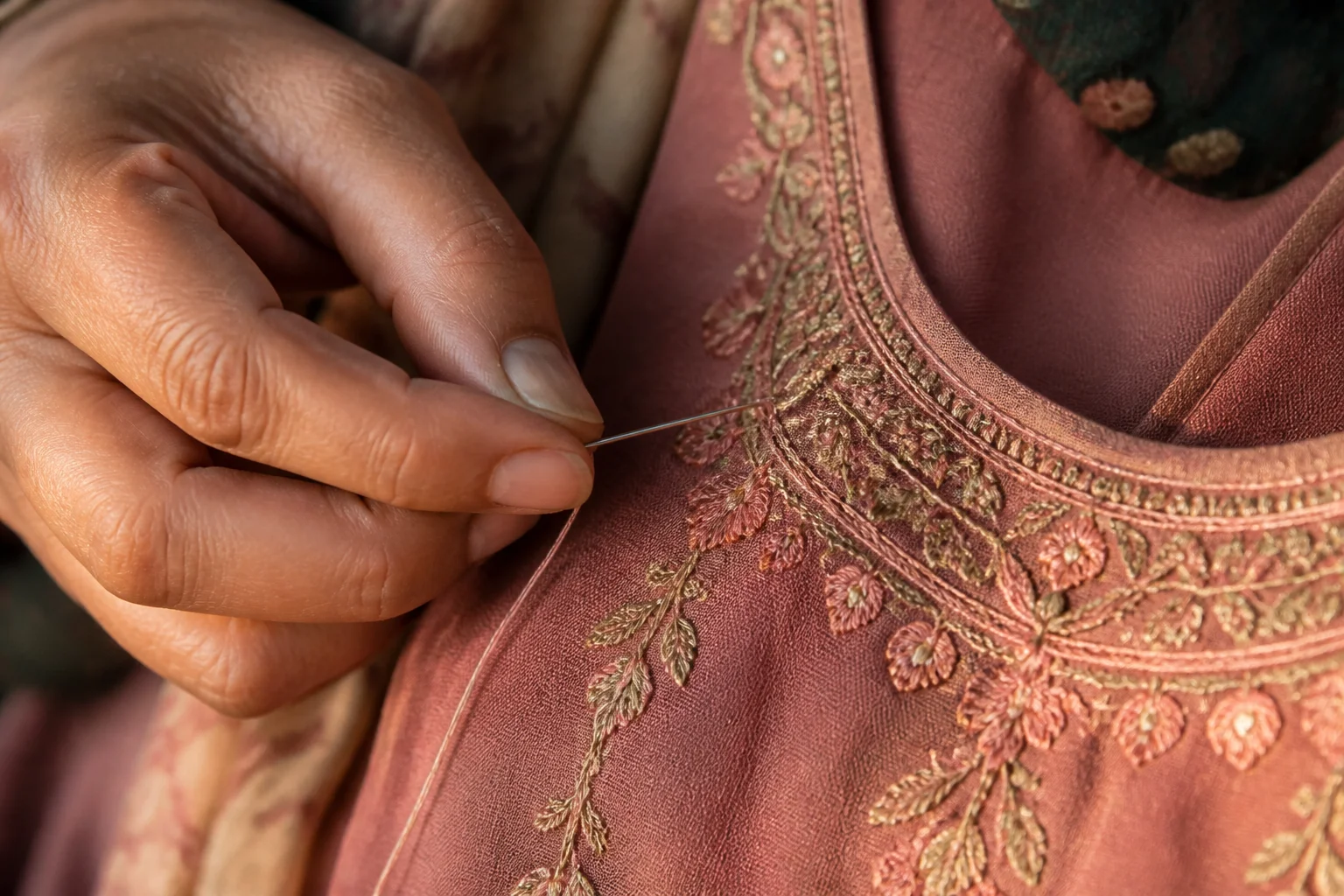
A design author. There is a studio, a team, a design intent — not a textile mill running a print across a stock-keeping range. The cut and the colour come from a person who thought about them.
A finished construction. Hems, seams, embroidery, lining, neckline binding, buttons, ties — all complete before the piece reaches the buyer. This separates designer dresses from unstitched fabric, which still has the tailoring stage ahead of it. For the deeper compare-and-contrast — including the stitched-to-order route — read the dedicated piece.
A sized range. The cut is engineered to fit a size, not measured to a person. Small, Medium, Large is the standard pattern at most Pakistani pret houses; some studios extend to XS or XL. Custom alterations may still happen at the buyer’s end, but the cut belongs to the chart.
What it does not mean, in modern Pakistani usage, is Western dresses. Designer Pakistani dresses sit firmly inside Pakistani silhouettes — kameez tunics, maxis, kaftans, co-ords, lounge sets, dupattas. The garments are Pakistani; the buying model is finished-and-sized. Those are two different things, and this guide is about both.
For the wider context — what modern Pakistani fashion looks like in 2026 across both designer pret and the adjacent registers — see the year’s aesthetic shifts in Pakistani fashion.
The marks of a designer pret piece
A piece earns the designer label when five properties show up together. None of them alone is decisive — but the five together is what separates a designer pret garment from one that is only finished-and-sized.
Fabric
Fabric is the first thing a designer studio chooses, and the first thing a careful buyer should look at. A pret chiffon should feel substantial enough to drape without clinging. A pret crepe should hold a structured line. A pret cotton should breathe without going limp after a single wash. Where the fabric was sourced — for the design, not from a stock roll — is what separates a designer line from a volume one.
Cut
A designer cut is a designed cut. A maxi falls from the empire waist; a kameez sits at the hip; a kaftan moves from the shoulder. The silhouette should read on the model and on the hanger. If a piece looks structured on the body and shapeless off it, the cut is not doing the work.
Finishing
The hem should be clean and even. The neckline binding should sit flat against the body without bubbling. The lining, where there is one, should be cut to the same shape as the outer garment and stitched in cleanly. Embroidery should be finished on the reverse — loose threads are a giveaway, and they show.
Sizing
S/M/L is the common range. Some studios go to XS or XL. The chart matters more than the size sticker. Bust, waist, and hip measurements should be published, and they should match the cut on the model.
Design integrity
The piece should belong to a thought-through line. Fabric, colour, silhouette resolved together by the design team before any one customer enters the picture. A stand-alone garment that does not sit inside a collection logic — different fabric, different finishing, different sensibility from its neighbours — is harder to read as designer work.
For a deeper read on three of those five marks — fabric, fit, and finishing — at the level of evaluating one garment before purchase, see how to evaluate women’s pret on fabric, fit, and finishing.
The categories worth knowing
Most Pakistani designer pret in 2026 lands inside seven or so garment families. A short tour of what each one is and what it is for.
Maxis are the floor-length pieces — A-line or empire-waisted, usually in chiffon, crepe, or organza for occasion-leaning pieces and cotton or linen-blend for casual. The shelf’s workhorse. For the designer maxi catalog, see the catalog.
Tunics and kameez are the hip-length or knee-length tops, worn over trousers or as a stand-alone in lighter cuts. Designer tunics show their work in the neckline shape, the sleeve cut, and the embroidery placement.
Kaftans are loose, from-the-shoulder garments. Inherently modest, inherently easy, designed to read elegant at any register from a family lunch to a formal evening.
Co-ord sets are a matched top-and-trouser piece, sold and worn as one. The matching is the design — fabric, embroidery, palette resolved across the pair.
Lounge wear is the at-home tier. Soft fabrics, easy cuts, modest enough to wear when family drops in.
Dupattas are the long scarves that complete or accent an outfit — sometimes sold as part of a set, sometimes as the standalone piece that lifts an existing one.
Exclusives are the small-run pieces, one-offs or near-one-offs that sit apart from the regular catalog. Worth picking up when one speaks; not restocked when it sells.
For the umbrella term these categories sit inside — and a definition of what pret means in modern Pakistani usage — see the dedicated explainer.
Choosing a designer dress by occasion
Pakistani occasion mapping is dense, and a buyer’s guide is only as useful as its register-of-occasion advice.

For everyday and family wear, the answer is usually a cotton or linen-blend tunic, a soft co-ord set, or a casual maxi in a quiet colour. Sleeves long, neckline modest, fabric breathable, embroidery minimal. The piece should hold up to a full day without demanding attention.
For festive afternoons — eid, a family lunch, a small daawat — a chiffon or crepe maxi in a clean solid, a co-ord with restrained embroidery, or a tunic with a worked neckline does the work. The register is dressed, not over-dressed.
For evenings and formal occasions — a nikkah, a mehndi as a guest, a walima — the piece can hold more weight. Heavier embroidery, a structured cut, a colour with depth. The piece carries the room rather than competing with it.
For wedding events as the host or close family, Pakistani fashion still leans toward stitched-to-order or couture for the principal pieces. Designer pret holds the second-tier slots — the events around the main event, the trousseau-but-not-bridal pieces, the dupatta that finishes an unstitched set. Pret is rarely the bridal lehnga; it is often everything else.
For an event-by-event read across the full Pakistani calendar — mehndi, nikkah, walima, baraat, eid, party, casual — see the occasion-by-occasion guide to choosing pret.
Buying online with confidence
Designer pret is increasingly an online category, which means the buyer’s read of a piece has to come from photos and a sizing chart rather than a hand on the fabric. Four checks make the read more reliable.
Read the sizing chart, not the size sticker. Bust, waist, hip in inches or centimetres, measured against your own body. A Small at one house is not always a Small at another.
Look for fabric weight cues. A studio that names the fabric — “medium-weight chiffon,” “structured crepe,” “linen-cotton blend” — is showing its work. Vague “premium fabric” copy is not.
Check the photo discipline. Designer pret studios shoot on consistent backgrounds, with the cut visible and the finishing legible. The hem should show. The neckline should sit. The fabric should drape on the model the way it should drape on you.
Verify the exchange policy. Most Pakistani pret houses offer an exchange window — eight to fourteen days is typical. The policy should be visible, not buried. If it is not, the piece is harder to buy with confidence.
Where Elrare sits
Elrare is one studio inside this shelf. Designed in-house, finished in-house, sized to S/M/L, shipped across Pakistan. The catalog covers maxis, tops, co-ords, kaftans, lounge wear, dupattas, and a small Exclusives line.
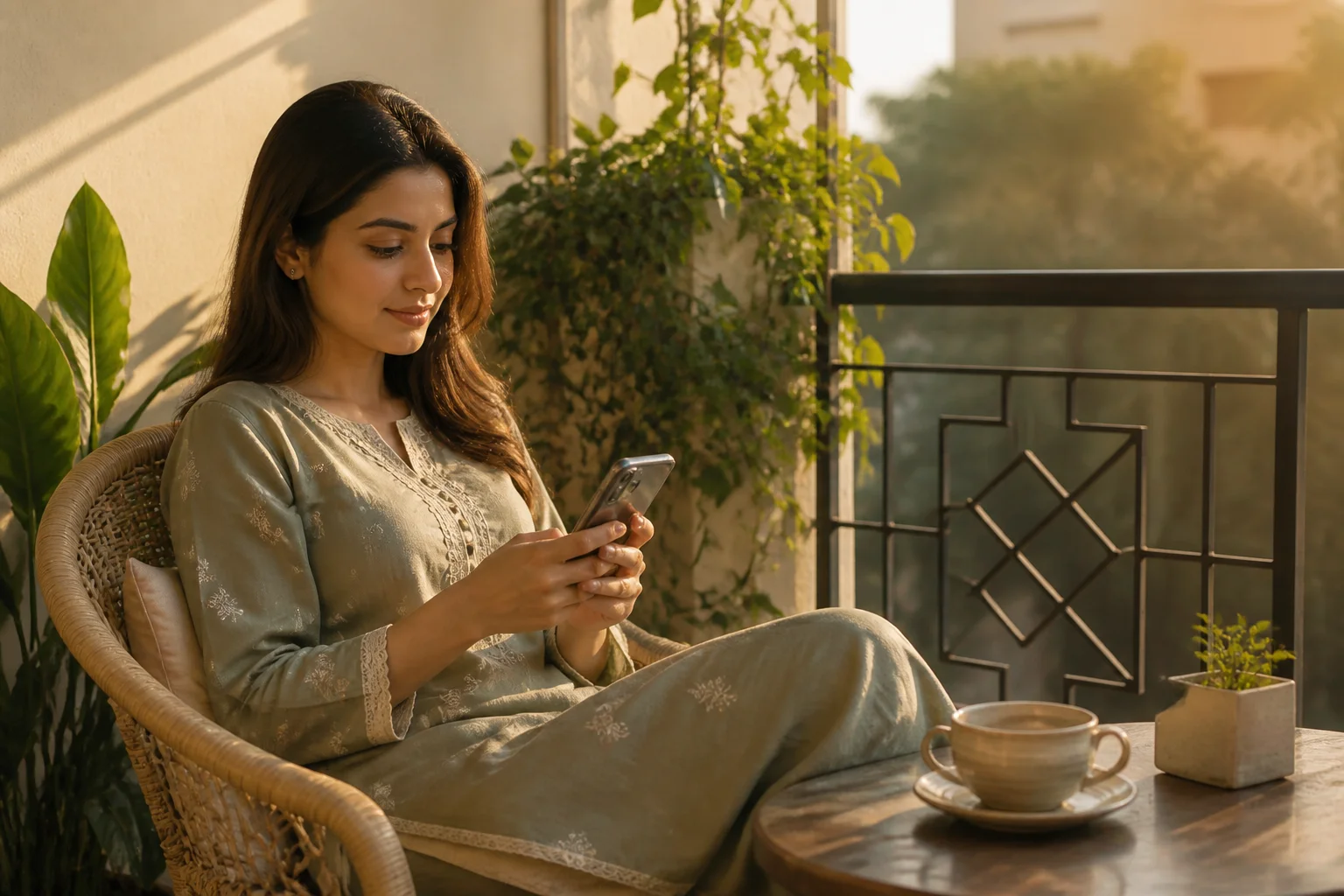
The brand’s posture is premium-leaning ready-to-wear — not couture, not fast fashion, not heritage textile mill at scale. Pieces are designed as a line, with fabric chosen for the silhouette and embroidery placed to read on the body. The team is small enough that the design decisions hold across the catalog.
The question of how to evaluate a Pakistani clothing brand — design philosophy, fabric sourcing, finishing standards, exchange policy — sits next to the question this guide answers. A separate buyer’s decision guide for Pakistani clothing brands covers the brand axis at length.
Anything in Elrare’s catalog that meets the five marks above belongs on the same shelf as the rest of Pakistan’s serious designer pret. For how the in-house studio works, read the About page.
FAQ
What counts as a Pakistani designer dress?
A Pakistani designer dress is a finished garment from an in-house design studio — designed as part of a collection, made in small runs, sized to a chart, and finished before it reaches the buyer. It sits inside Pakistani silhouettes (maxis, kameez tunics, kaftans, co-ords, lounge wear, dupattas), not Western ones.
How are Pakistani designer dresses different from regular pret?
The line is real but soft. All designer dresses are pret; not all pret is designer. The mark is whether the piece carries a design author — an in-house studio with intent — or whether it is a finished-and-sized garment without a design line behind it. Fabric weight, cut precision, finishing detail, and collection logic are the visible signals.
Where can I buy Pakistani designer dresses online?
From in-house Pakistani design studios. Most ship nationally. Elrare is one option — designed in-house, finished in-house, sized to S/M/L, with a published sizing chart and a clear exchange policy. Other Pakistani pret houses operate on similar models.
What sizes do Pakistani designer dresses come in?
Small, Medium, and Large is the standard range at most Pakistani designer pret houses, including Elrare. Some studios extend to XS or XL. The published sizing chart — bust, waist, hip in inches or centimetres — is the right thing to read before ordering, not the size sticker alone.
Are Pakistani designer dresses suitable for wedding events?
For events around the main event — mehndi as a guest, a family dholki, walima as a guest, a nikkah ceremony where modesty leads — designer pret holds up well. For the bridal piece itself, Pakistani fashion still leans toward stitched-to-order or couture. Pret is rarely the bridal lehnga; it is often everything else.
A Pakistani designer dress is, in the end, a finished thought — designed to fit, made to wear a season, ready to read on the body the way it reads on the rail.