
Buying from a brand is a longer relationship than buying a dress.
The brand you decide to keep going back to is the one whose sizing you’ve come to trust, whose fabric default doesn’t surprise you, whose return policy has actually worked the one time you needed it. That decision is built up over several purchases, but it doesn’t have to be built up blind. Before you put a brand into that rotation, there are things you can look at — and they tell you almost everything.
This is not a list of brands. It is the framework for evaluating one.
What “Pakistani clothing brand” means in 2026
The phrase covers a wider landscape than it used to. At one end sit the heritage textile mills that built their names on unstitched lawn and printed fabric, and have since added stitched lines. In the middle sit the long-established designer houses — couture-leaning, occasion-heavy, with prices and runway moments to match. Closer to where most modern Pakistani women live now sit the ready-to-wear pret labels — fully stitched, sized in S, M, and L, designed for everyday occasion-wear rather than bridal.
There are also the marketplace-only sellers and the social-led drops that arrive in your feed without a website behind them. Some of these are excellent. Many are not. The framework below applies to all of them.
The piece you’re considering matters less, here, than the operation behind it. You are choosing who to be a customer of.
Eight things to look at when you’re choosing a Pakistani clothing brand
1. Range across occasions and categories
Open the catalog. Walk through it. Does it cover the actual shape of your year?
A brand that only sells bridal cannot become your regular brand if you do not get married often. A brand that only does lawn cannot dress you for a baraat. The Pakistani calendar is occasion-dense — eid, mehndi, shaadi, walima, family dinners, work, the long quiet weeks in between — and a brand worth keeping in your rotation covers more than one slice of that.
Look for breadth across categories (maxis, kaftans, tops, co-ords, lounge wear, dupattas) and across occasion register (everyday through to wedding-guest). Depth in one category is fine; depth in only one occasion, less so. The brand that can dress a Tuesday lunch and a nikkah from the same site is the brand you can settle into.
2. Sizing as a brand commitment, not as a chart
Every brand has a size chart. Fewer brands have a sizing system — a discipline that holds across products, so that a Small in one piece fits the same person as a Small in another.
Read the chart. Then read three or four product descriptions and see whether the same words come back. “Slightly relaxed at the bust.” “Cut close at the waist.” “Falls to the floor.” A brand that talks about fit consistently across its catalog is a brand that has decided what fit means for it.
Inconsistency here is the single most common reason women stop buying from a brand. If the sizing in one dress runs two inches different from the sizing in another, no return policy can make up for it. Look for a brand that publishes one size chart, holds to it, and writes the same fit language across the catalog.
3. Fabric standards across the catalog
Showpiece dresses are easy. Fabric standards on the everyday range are harder, and far more telling.
Look at what the brand uses for its mid-tier and lower-tier pieces, not the flagship ones. If the chiffon is described as “premium chiffon” on the bridal maxi but listed as just “chiffon” on the everyday piece, you can guess the rest. If the brand is upfront about whether something is georgette or chiffon or lawn or crepe — and what weight, and what hand — that is a brand that knows its fabric library.
The brand’s fabric vocabulary is a tell. Vague language (“luxurious fabric,” “premium material”) usually means the brand doesn’t want you to look too closely. Specific language (“soft chiffon with a fluid drape,” “breathable lawn for hot weather”) usually means they do.
4. Modesty as design intelligence
Pakistani buyers carry a range of preferences here, and the right brand for you is the one whose default lines up with yours.
Read the descriptions and look at the photographs. What is the brand’s natural neckline — round, V, square? What sleeve does it default to — full-length, three-quarter, cap, sleeveless? Does it slit or not? Does it line or not?
A brand whose every piece needs a dupatta thrown over it to feel covered is a brand whose design philosophy doesn’t share your priorities. A brand whose pieces are modest in cut as a design property — not as a constraint, not as a virtue claim — is doing the work upstream. Both kinds exist. You’re choosing which one fits your wardrobe without alteration.
5. Construction and finish as everyday standard
What the brand does on its highest-priced piece tells you what it can do. What the brand does on its mid-priced piece tells you what it usually does.
Look at hems. Look at lining. Look at how the brand handles internal seams in the photography — if every product shot is exterior-only and there is no honest construction photo anywhere on the site, that is a choice the brand is making. Read the descriptions for whether finishing is mentioned at all. A brand that talks about garment-level quality marks across the catalog is a brand that wants you to look closely.
In-house finishing, where it exists, is worth weighting. A brand that finishes its own pieces tends to hold a quality bar that subcontracted finishing cannot match consistently.
For the same evaluation pulled inward from the brand level to the single-garment level, see how a single pret garment reads on fabric, fit, and finishing.
6. The return and exchange policy — written and lived
Read the policy. Then look for the lived version of it.
The written policy tells you what the brand has agreed to. The lived version — visible in customer comments, in social DMs, in the patience of the brand’s responses when something has gone wrong — tells you what the brand actually does. The two are not always the same.
What you want: a return window long enough to receive, try on, and decide (eight days from delivery is standard for Pakistani pret); a mail-in option for cities outside the brand’s home base; a clear statement of who pays return shipping; and a defective-item path that puts the brand on the hook. Anything thinner than that is the brand telling you they do not expect to need a return policy — usually because the volume is too small to have stress-tested one.
7. How the brand shows its garments
Photographs are the brand’s first promise. Examine them.
Is the photograph of the fabric — close, well-lit, in colour the actual fabric will arrive in — present anywhere on the product page? Is there a back view? Is there a worn shot from more than one angle? Are the models a range of heights and proportions, or only one body type repeated across the entire catalog?
Photo honesty matters because it is the only sample you get before purchase. A brand that shows the fabric clearly is a brand that is comfortable with you seeing it. A brand whose photographs all look stylized and distant — refined from twenty feet, unreadable up close — is a brand whose photography is doing work the garment may not be able to do in person. How to read a brand’s online shopfront in detail is a longer piece in itself.
8. Price posture
We don’t write price language into our own copy, and the reason we don’t is the same reason you should look at how a brand handles price.
A brand whose entire copy strategy is price-shouting — “biggest sale ever,” urgent buy-now framing, “premium without the markup” — is a brand telling you that price is the thing they want you to think about. A brand that names what something costs without staging a feeling around it is a brand that has chosen to compete on garment, not on discount.
The price you pay is between you and the storefront. The way the brand talks about price tells you what the brand thinks is worth your attention.
A note on brand voice
How a brand sounds is a tell about how it thinks.

Read three product descriptions in a row. Are they descriptive — fabric, cut, finish, occasion — or are they evaluative, full of feelings-adjectives and influencer-style enthusiasm? A brand that describes the garment trusts the garment. A brand that hypes the garment is usually compensating for it.
Read the About page. Does it sound like a small studio that has done the thinking, or does it sound like a marketing brief filled in? The first is rare and worth following. The second is everywhere and easy to skip.
Where Elrare sits in this picture
Briefly, because the piece is a framework and not a pitch.
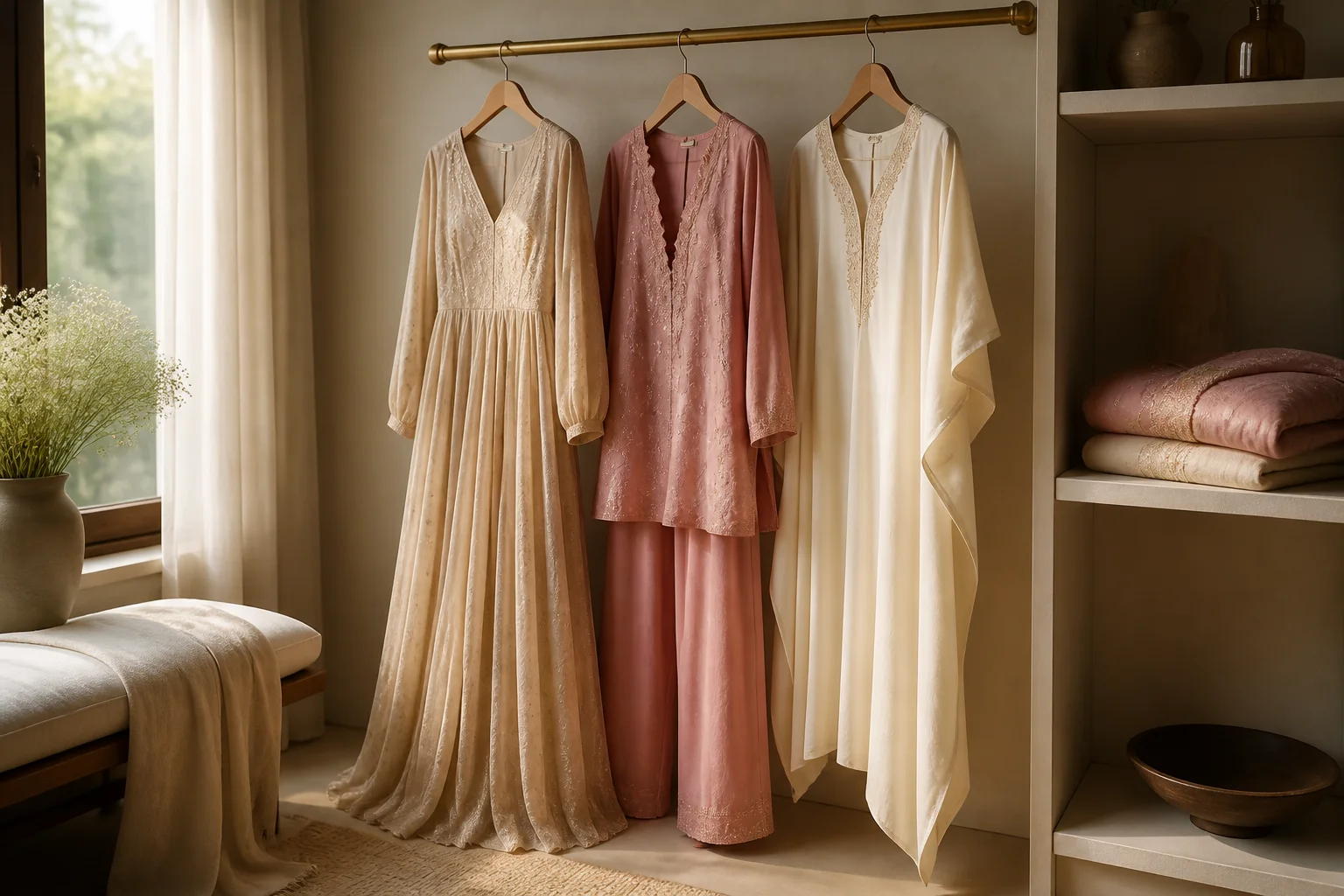
We are a premium ready-to-wear pret brand for modern Pakistani women, designed and finished in-house. Our catalog spans maxis, tops, co-ords, kaftans, lounge wear, dupattas, and a small Exclusives category — across everyday and occasion register. Every Elrare piece is modest in cut as a design property, sized in Small, Medium, and Large from a single chart that holds across the catalog, and finished before it leaves us. Our return and exchange window is published and lived; the policy sits at the shipping and exchanges page.
We don’t write price language and we don’t run urgency vocabulary. If our work fits your wardrobe, you will see it in the maxi line first — that is where the brand’s voice and our fabric defaults are clearest.
You can apply the framework above to us. We would prefer that you did.
FAQ
What is the best Pakistani clothing brand?
There is no single best brand — there is the brand whose sizing, fabric defaults, modesty stance, and return policy line up with how you actually shop. The eight criteria above are how to figure out which brand that is for you.
How do I know if a Pakistani clothing brand is trustworthy?
Read the return policy and then look for the lived version of it in customer comments. Look at the brand’s photography for fabric honesty. Read three product descriptions in a row and see whether the language stays consistent. A brand that holds a standard across its catalog and writes about it plainly is the trustworthy signal.
What’s the difference between a Pakistani clothing brand and a Pakistani designer brand?
In current usage, “designer” tends to imply runway-adjacent, occasion-led, and priced above mass market — sometimes couture, sometimes bridal-heavy. “Clothing brand” is broader and covers ready-to-wear pret, lifestyle labels, and heritage textile lines. The distinction is loose; what matters is what the brand actually sells, not how it labels itself.
How many Pakistani clothing brands should I buy from?
Two or three is the usual sweet spot — one for everyday, one or two for occasion. Many of the eight criteria become easier to evaluate once you’ve bought from a brand twice, so the cost of trying a new brand is real. A short rotation that’s been thoroughly tested usually serves better than a long list that’s been tested once each.
Are online Pakistani clothing brands as reliable as in-store ones?
Increasingly, yes — but with the caveat that the eight criteria above apply more rigorously online, where you can’t feel the fabric in advance. Brands that have built clear size charts, fabric photography, and honest return policies are often more reliable online than older brick-and-mortar names that haven’t translated to online buying well.
Should I judge a brand by its bridal pieces?
No — judge it by its mid-tier and everyday pieces. The bridal piece is the brand’s showpiece and tells you what they can do at their best. The everyday piece tells you what they do most of the time. The second number is the one that matters for becoming a repeat customer.
Becoming a customer of a Pakistani clothing brand is a small commitment that pays back across years. The eight criteria above are how to make that commitment well.