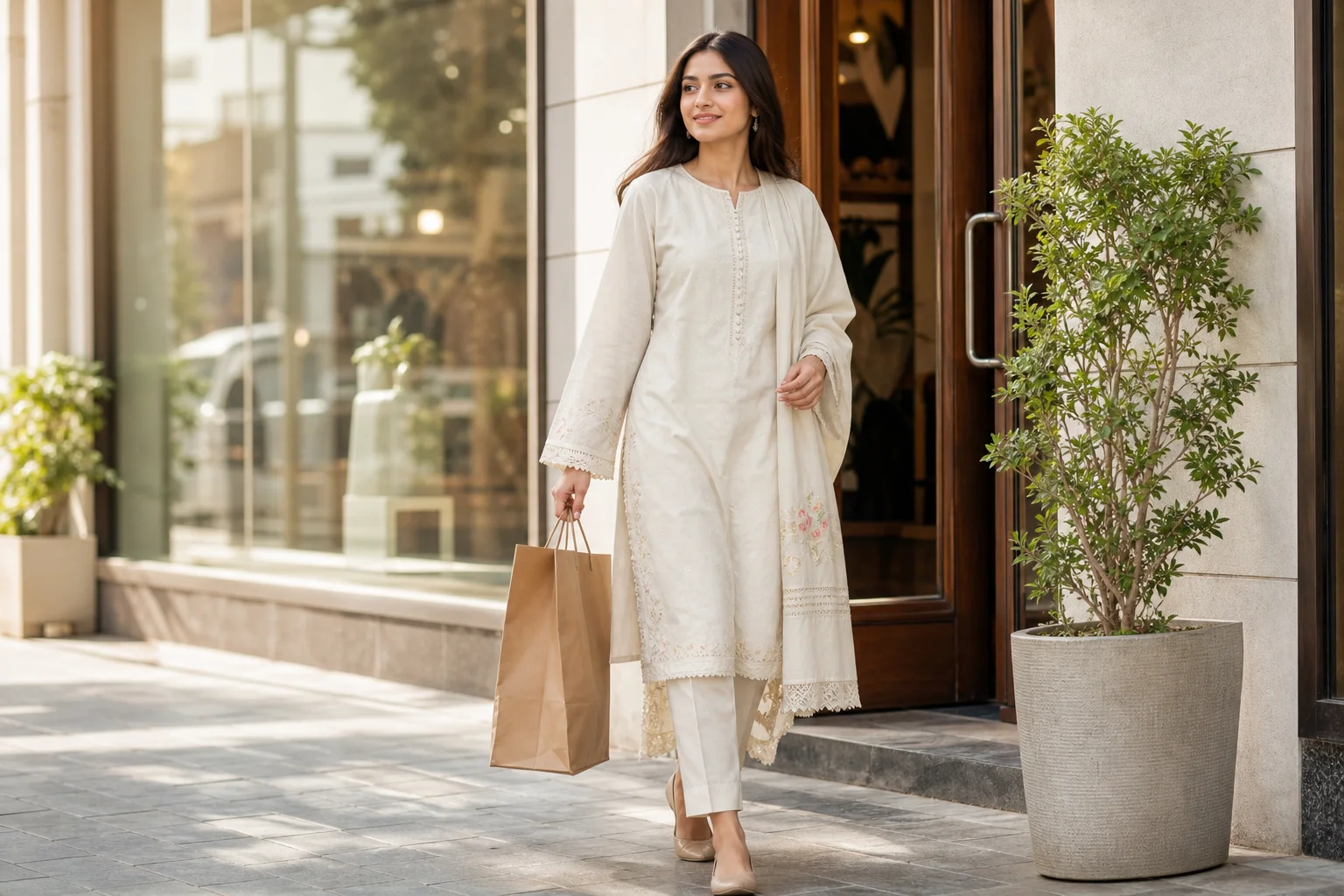
Pret is a finished womenswear garment, designed and sized, ready to wear.
In Pakistan the word does a lot of work. It describes the bulk of what most women actually buy now — a designed piece that arrives complete, with hems, seams, embroidery, and finishing already done. It is the modern default for Pakistani womenswear, and the word for it that has settled into common use is pret.
This piece is for the reader who wants the word defined cleanly. What pret means. What makes a garment count as pret. How it sits next to the older buying habits — unstitched fabric, stitched-to-order, couture. Why it became the default in the first place. And how to read a pret piece well when one is in front of you.
For the longer version — catalog, fabric guide, occasion mapping, care — see the full Pakistani pret guide.
What pret means
Pret is short for prêt-à-porter — French for “ready to wear.” The full term started in mid-twentieth-century European fashion as the alternative to haute couture, and it travelled into South Asian fashion vocabulary through the design houses that emerged here in the 1990s and 2000s.
In modern Pakistani usage the word has been local for a long time. Most buyers no longer think of it as borrowed. Pret, pret wear, ready to wear, ready to wear pret — the variations point at the same shelf. A pret piece is a designed, finished, sized garment available off the rail.
The two terms — pret and ready to wear — are used interchangeably by Pakistani brands and Pakistani shoppers. One is older and slightly more formal-sounding; the other reads as plain modern description. Most catalog pages use both.
For readers who want the relationship between the two words unpacked at length — and the twenty-year shift behind it — see ready to wear vs pret, the vocabulary explained.
What the word does NOT mean, in Pakistani usage, is Western dresses. Pret here covers the full range of Pakistani silhouettes — kameez tunics, maxis, kaftans, co-ords, lounge sets, dupattas. The garments are Pakistani; the buying model is finished-and-sized. Those are two different things and pret is about the second one.
What makes a garment pret
Three properties make a garment pret in modern Pakistani usage.
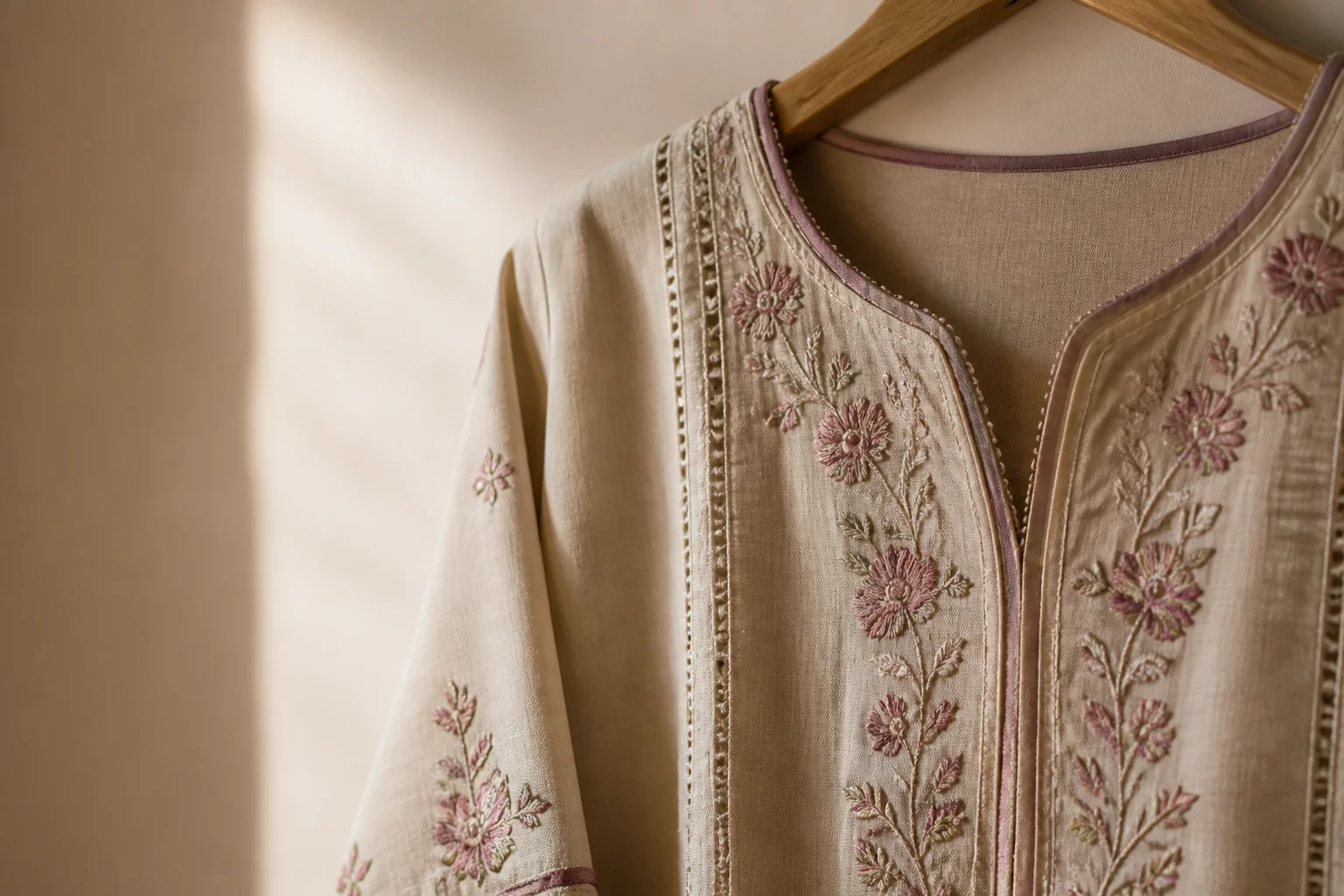
It is sold finished. Hems, seams, embroidery, lining, neckline binding, buttons, ties, dupatta edging — all complete at the studio or workshop level before the piece reaches the buyer. The garment arrives in one box, ready to wear with no further work.
It is sized to a standard range. Small, Medium, and Large is the common pattern in Pakistan; some brands extend the range. The cut is designed to fit a size, not a person. Custom alterations may still happen at the buyer’s end — taking in a waist, adjusting a hem length — but the piece is engineered to a sizing chart, not a measuring tape.
It belongs to a designed collection. A pret piece sits inside a thought-through line. Fabric chosen, colour chosen, silhouette resolved by the in-house design team before any one customer enters the picture. That last point is what separates pret from older “stock garments.” Pret pieces are designed. The fabric is sourced for the design, not pulled from a roll of whatever was in stock. The cut belongs to a season or a collection. The finishing matches the price tier.
Together, those three properties — finished, sized, designed — define the category. A piece that is finished but not sized (a one-off couture piece) is not pret. A piece that is sized but not designed (a generic stock kurti) is not pret in the modern sense either, though the older usage of the word stretched that far.
Most of what sits in Elrare’s catalog is pret in this strict sense — finished, sized to S/M/L, part of a designed collection from a single in-house studio.
Pret vs the alternatives
The cleanest way to understand pret is to set it next to the other ways a Pakistani woman can buy a garment.
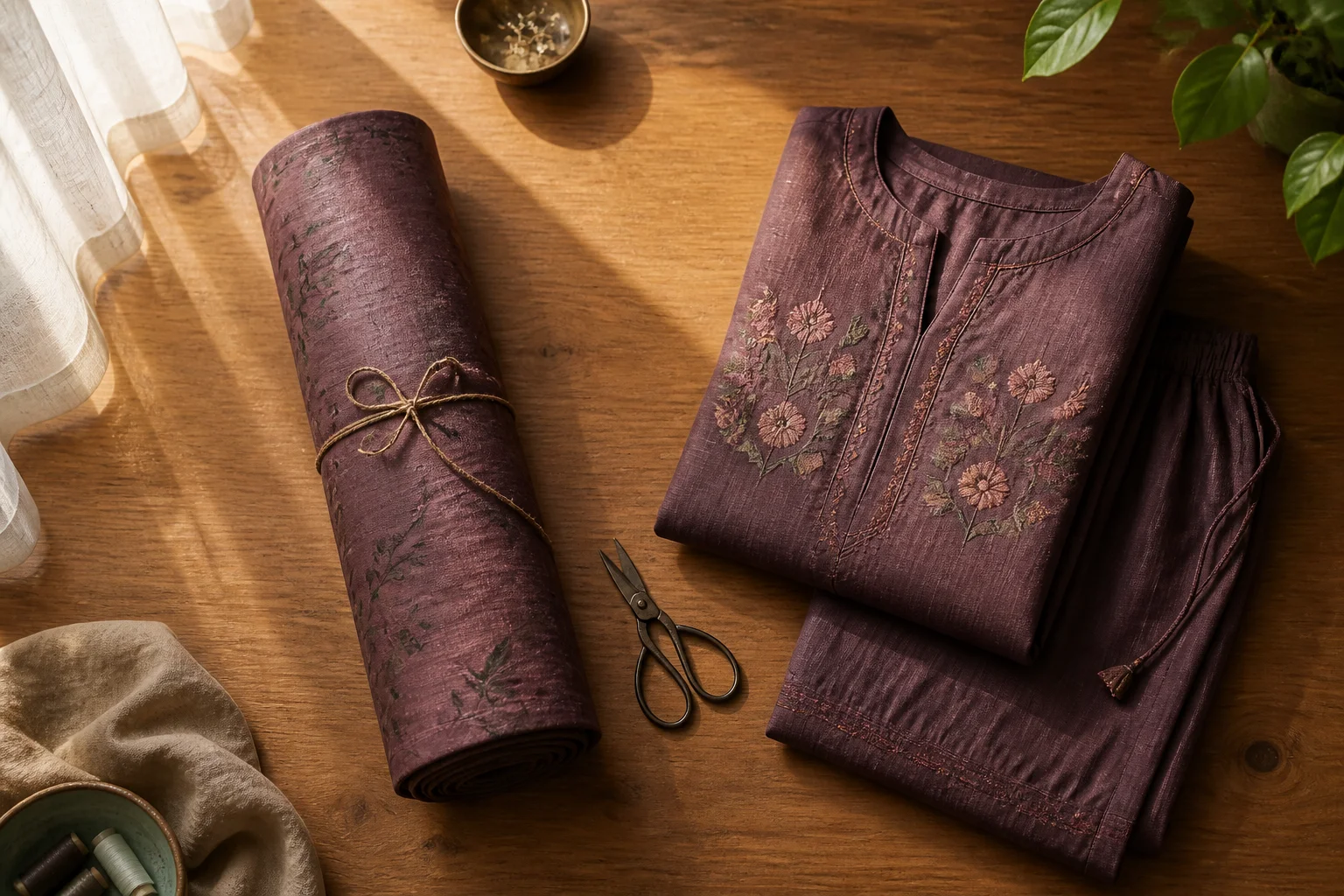
Pret vs unstitched. Unstitched is fabric. A buyer purchases a kameez piece, a trouser piece, and a dupatta — typically three pieces, sometimes two — and takes the bundle to a tailor. The tailor measures, asks about neckline and sleeve length, and sews the garment to specification. The fit is exact; the turnaround is weeks; the cut depends on the tailor’s hand. Pret resolves all of those decisions upstream and ships the finished result. Unstitched still owns occasion-heavy and bridal territory in Pakistan. Pret owns nearly everything else — including most of what sits in the Elrare maxis collection.
For the longer read on this comparison — when each format makes sense for a specific purchase, with the decision-points laid out garment-by-garment — see the dedicated pret vs unstitched comparison for Pakistan.
Pret vs stitched-to-order. Stitched-to-order sits between the two. A designer or a small studio offers a fabric and a silhouette, and a buyer commissions a single piece in her own measurements. The cut belongs to the designer; the fit belongs to the buyer. The turnaround is shorter than full unstitched-to-tailor but longer than pret. The pricing is usually a tier above pret. Stitched-to-order is alive and well in Pakistani fashion, especially for occasion pieces; pret is the everyday equivalent.
Pret vs couture. Couture is the top tier — single, hand-finished pieces, often for weddings or formal events, with bespoke fitting and significant lead time. Pret and couture are not in competition. A Pakistani woman might own a couture piece for her baraat and twenty pret pieces for everything else. The two slots are different.
Pret vs fast fashion. Fast fashion is finished and sized too, but the design and the finishing are pulled toward volume and speed at the cost of fabric weight, fit consistency, and embroidery quality. Pret in Pakistan tends to sit a tier above — slower production, sourced fabric, in-house finishing. The line between premium pret and fast fashion is not always clean, but the markers are real: fabric weight, hem quality, lining presence, embroidery handwork.
Why pret became the modern default
Pret moved from a niche to the default in Pakistani womenswear over roughly twenty years. Three things drove the shift.
Sizing confidence. As Pakistani brands worked out their sizing charts and the buyers learned which brands fit which way, the central anxiety of finished-garment shopping — “will it fit?” — became manageable. A Small at one house meant something close to a Small at another. Returns and exchanges got easier. The category became reliable.
Online retail. From around 2018 forward, Elrare and other Pakistani pret houses started shipping nationally with confidence. Buyers in Karachi could shop a Lahore studio without travelling. Buyers in smaller cities could reach the whole catalog. Online retail rewards finished-and-sized goods — unstitched works against the model. Pret won the channel almost by default.
Design houses. In parallel, the design tier matured. Brands stopped being either textile mills extending their fabric range or boutique one-offs and became in-house design studios producing seasonal pret lines. The garment got better. Cuts settled into shapes that worked. Finishing levelled up. The piece on the rail started feeling considered, not stock.
The result, in 2026, is that pret carries the weight of everyday Pakistani womenswear shopping. Maxis, tops, kaftans, co-ords, lounge wear, dupattas, small exclusive collections — all of it reads as pret now. A piece can be casual or occasion-leaning and still belong to the category. What matters is that it arrived finished.
For the wider aesthetic frame around that 2026 state — quieter palettes, considered embroidery, longer line — see what modern Pakistani fashion looks like in 2026.
How to read pret well as a buyer
Pret is a finished good, and like any finished good it rewards a careful look.
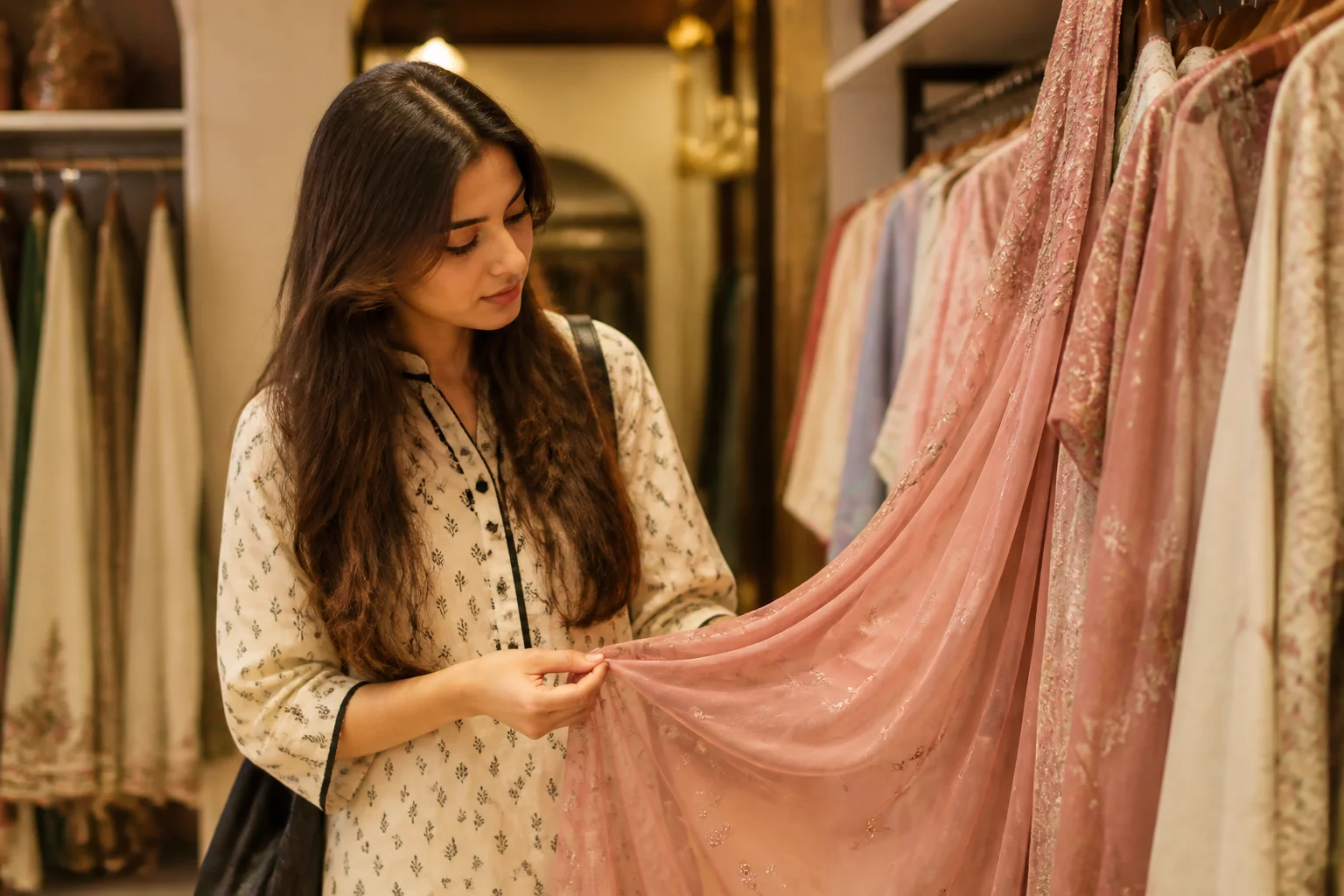
Look at the fabric weight. Hold the piece. A pret chiffon should feel substantial enough to drape without clinging; a pret crepe should hold a structured line; a pret cotton should breathe without going limp after one wash. Fabric weight is the first signal of where a piece sits in the tier.
Look at the finishing. The hem should be clean and even. The neckline binding should sit flat against the body without bubbling. The lining, if there is one, should be cut to the same shape as the outer garment and stitched in cleanly. Embroidery should be finished on the reverse — loose threads are a give-away.
Look at the cut. A pret cut is a designed cut. A maxi falls from the empire waist; a kameez sits at the hip; a kaftan moves from the shoulder. The silhouette should read on the model AND on the hanger. If the piece looks structured on the model and shapeless off her, the cut is not doing the work.
Look at the size range. S/M/L is standard at most Pakistani pret houses. Some studios extend to XS or XL. The sizing chart matters — read it before ordering. Most pret houses, including the Elrare studio, publish a chart with bust, waist, and hip measurements per size.
A piece that reads well across all four of those checks is a piece you can buy confidently online.
For the buyer who wants to commit to an online order with full confidence, the longer guide on buying Pakistani dresses online with confidence covers product photography, size charts, fabric descriptions, and return windows.
For the wider buyer’s read on Pakistani designer dresses at the garment-design level, see the wider buyer’s guide for Pakistani designer dresses — same questions, brand-design frame, more depth.
FAQ
What does pret mean?
Pret is short for prêt-à-porter, French for “ready to wear.” In Pakistani usage it means a finished womenswear garment — designed, finished, and sized — sold off the rail in standard sizes rather than commissioned from a tailor.
Is pret wear the same as ready-to-wear?
Yes. In modern Pakistani usage pret, pret wear, and ready to wear are used interchangeably. They point at the same shelf — finished, sized garments from in-house design houses. For depth on the full pret catalog, see the pret guide.
What is the difference between pret and unstitched?
Unstitched is fabric sold by length — a buyer purchases the kameez, trouser, and dupatta pieces as cloth and takes them to a tailor for stitching. Pret is the finished garment, designed and sewn before it reaches the buyer, sold in standard sizes. Unstitched still works for occasion-heavy and bridal pieces; pret is the everyday default.
What sizes does Pakistani pret come in?
Small, Medium, and Large is the common range at most Pakistani pret houses, including Elrare. Some studios extend to XS or XL. Sizing charts vary slightly between brands — always check the published chart for bust, waist, and hip measurements before ordering.
Where can I buy modern Pakistani pret?
From in-house Pakistani design studios. Most ship nationally. Elrare is one option — designed in-house, finished in-house, sized to S/M/L, shipped across Pakistan. Other Pakistani pret houses operate on similar models.
Pret is the modern Pakistani wardrobe — finished, fitted, ready when you are.